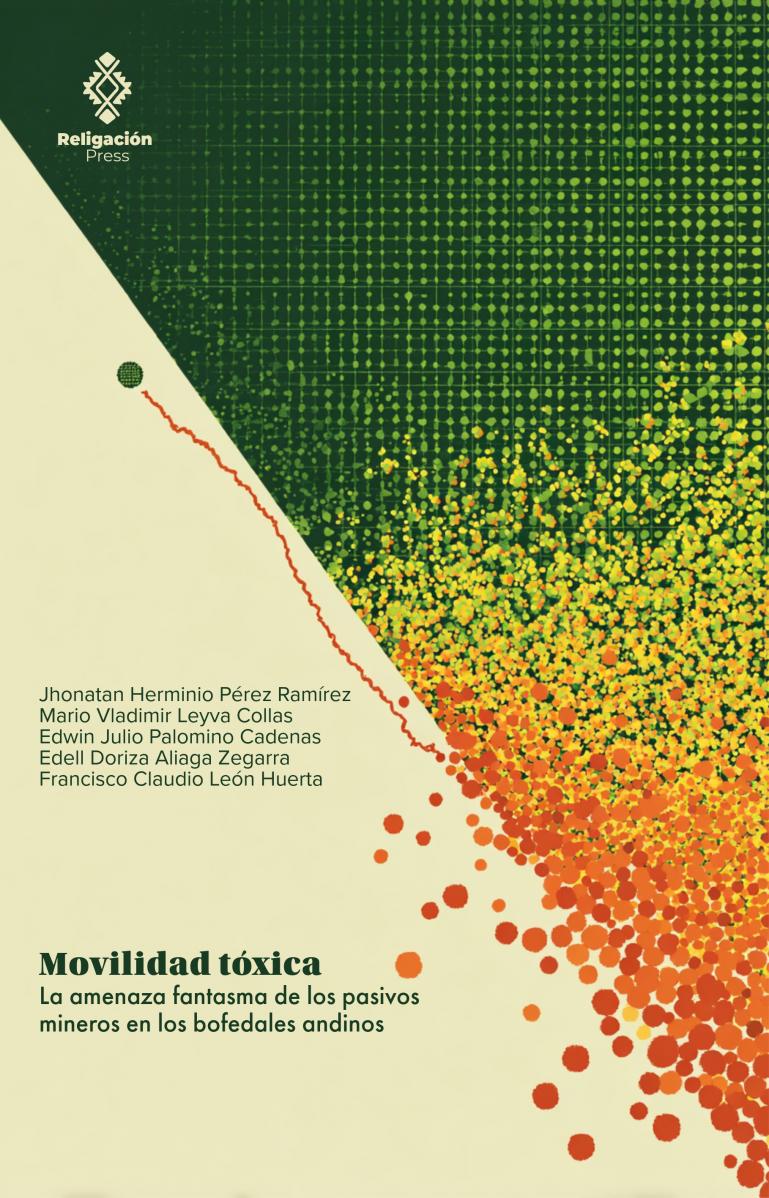
Toxic Mobility. The Phantom Threat of Mining Liabilities in the Andean Bofedales
Keywords:
Metal mobility; Mining Environmental Liability; Acid Mine Drainage; Bofedal; Chemical speciation.Synopsis
This book addresses an invisible environmental crisis in the heart of the Andes. It investigates the impact of the Mesapata Mining Environmental Liability (PAM), a persistent source of pollution that releases Acid Mine Drainage (AMD) laden with heavy metals—arsenic, lead, cadmium, and chromium—into a fragile bofedal (high-altitude peatland). The work focuses on deciphering a critical process: toxic mobility. Through meticulous research, it evaluates how these elements are speciated in the soil, transferred to the vegetation that supports local livestock, and infiltrate groundwater. Beyond diagnosis, this study not only quantifies the degree of degradation of ecosystem services but also proposes concrete management strategies to contain this threat and protect these vital ecosystems.
Downloads
Download data is not yet available.
References
Balali-Mood, M., Naseri, K., Tahergorabi, Z., Khazdair, M. R., & Sadeghi, M. (2021). Toxic Mechanisms of Five Heavy Metals: Mercury, Lead, Chromium, Cadmium, and Arsenic. Frontiers in Pharmacology, 12. https://doi.org/10.3389/fphar.2021.643972
Balmuri, S. R., Selvaraj, U., Kumar, V. V., Anthony, S. P., Tsatsakis, A. M., Golokhvast, K. S., & Raman, T. (2017). Effect of surfactant in mitigating cadmium oxide nanoparticle toxicity: Implications for mitigating cadmium toxicity in environment. Environmental Research, 152, 189–197. https://doi.org/10.1016/j.envres.2016.10.005
Banerjee, S., Datta, S., Chattyopadhyay, D., & Sarkar, P. (2011). Arsenic accumulating and transforming bacteria isolated from contaminated soil for potential use in bioremediation. Journal of Environmental Science and Health–Part A Toxic/Hazardous Substances and Environmental Engineering, 46(14), 1736–1747. https://doi.org/10.1080/10934529.2011.623995
Bourg, A. C. M. (1995). Speciation of Heavy Metals in Soils and Groundwater and Implications for Their Natural and Provoked Mobility. In Heavy Metals (pp. 19-31). Springer Berlin Heidelberg. https://doi.org/10.1007/978-3-642-79316-5_2
Brookins, D. G. (1988). Eh-pH diagrams for geochemistry. Springer Verlag. https://doi.org/10.1007/978-3-642-73093-1
Caporale, A. G., & Violante, A. (2016). Chemical Processes Affecting the Mobility of Heavy Metals and Metalloids in Soil Environments. Current Pollution Reports, 2(1), 15–27. https://doi.org/10.1007/s40726-015-0024-y
Castillo, L., Satalaya, C., Paredes, Ú., Encalada, M., Zamora, J., & Cuadros, M. (2021). Pasivos ambientales en el Perú. Contraloría General de la República.
Cruz, M., & Guzmán, Á. (2007). La contaminación de suelos y aguas. Su prevención con nuevas sustancias naturales. Universidad de Sevilla.
Czikkely, M., Neubauer, E., Fekete, I., Ymeri, P., & Fogarassy, C. (2018). Review of heavy metal adsorption processes by several organic matters from wastewaters. Water, 10(10). https://doi.org/10.3390/w10101377
Defo, C., Kfuban, Y. B. P., Kaur, R., & Bemmo, N. (2017). Spatial distribution of heavy metals in groundwaters and health risks associated in the Ntem watershed, Yaoundé, Cameroon. Water Science and Technology: Water Supply, 17(3), 855–868. https://doi.org/10.2166/ws.2016.178
Dianyi Yu, M. D. (2008). Chromium (Cr) toxicity. Agency for Toxic Substances and Disease Registry. https://n9.cl/u90ek
Domergue, F. L., & Vedy, J. C. (1992). Mobility of heavy metals in soil profiles. International Journal of Environmental Analytical Chemistry, 46(1-3), 13–23. https://doi.org/10.1080/03067319208026993
Duffus, J. H. (2002). “Heavy metals”–A meaningless term? (IUPAC Technical Report). Pure and Applied Chemistry, 74(5), 793–807. https://doi.org/10.1351/pac200274050793
Fang, W., Wei, Y., & Liu, J. (2016). Comparative characterization of sewage sludge compost and soil: Heavy metal leaching characteristics. Journal of Hazardous Materials, 310, 1–10. https://doi.org/10.1016/j.jhazmat.2016.02.025
Gemeda, F. T., Guta, D. D., Wakjira, F. S., & Gebresenbet, G. (2021). Occurrence of heavy metal in water, soil, and plants in fields irrigated with industrial wastewater in Sabata town, Ethiopia. Environmental Science and Pollution Research, 28(10), 12382–12396. https://doi.org/10.1007/s11356-020-10621-6
Hu, J., Zhou, S., Wu, P., & Qu, K. (2017). Assessment of the distribution, bioavailability and ecological risks of heavy metals in the lake water and surface sediments of the Caohai plateau wetland, China. PLOS ONE, 12(12). https://doi.org/10.1371/journal.pone.0189295
Kumar, A., Kumar, A., Cabral-Pinto, M., Chaturvedi, A. K., Shabnam, A. A., Subrahmanyam, G., Mondal, R., Gupta, D. K., Malyan, S. K., Kumar, S. S., Khan, S. A., & Yadav, K. K. (2020). Lead toxicity: Health hazards, influence on food chain, and sustainable remediation approaches. International Journal of Environmental Research and Public Health, 17(7). https://doi.org/10.3390/ijerph17072179
Kumari, N., & Jagadevan, S. (2016). Genetic identification of arsenate reductase and arsenite oxidase in redox transformations carried out by arsenic metabolising prokaryotes – A comprehensive review. Chemosphere, 163, 400–412. https://doi.org/10.1016/j.chemosphere.2016.08.044
Lytle, D. A., & Schock, M. R. (2005). Formation of Pb(IV) oxides in chlorinated water. Journal–American Water Works Association, 97(11), 102–114.
MINAM. (2015). Guía para la elaboración de estudios de Evaluación de Riesgos a la Salud y el Ambiente (ERSA) en sitios contaminados. Ministerio del Ambiente.
MINAM. (2019). Guia de evaluación del estado del ecosistema de bofedal. Ministerio del Ambiente.
Miranda, L. S., Wijesiri, B., Ayoko, G. A., Egodawatta, P., & Goonetilleke, A. (2021). Water-sediment interactions and mobility of heavy metals in aquatic environments. Water Research, 202. https://doi.org/10.1016/j.watres.2021.117386
Pagnanelli, F., Moscardini, E., Giuliano, V., & Toro, L. (2004). Sequential extraction of heavy metals in river sediments of an abandoned pyrite mining area: Pollution detection and affinity series. Environmental Pollution, 132(2), 189–201. https://doi.org/10.1016/j.envpol.2004.05.002
Palomino Cadenas, J. H. (2022). Movilidad del As, Pb, Cd y Cr en el bofedal del entorno del pasivo ambiental minero de Mesapata, Ancash-Perú, 2022-2023 [Proyecto de tesis, Universidad Nacional]
Pavesi, T., & Moreira, J. C. (2020). Mechanisms and individuality in chromium toxicity in humans. Journal of Applied Toxicology, 40(9), 1183–1197. https://doi.org/10.1002/jat.3965
Solano, A. M. (2005). Estudio de la movilización de metales pesados. In Movilización de metales pesados en residuos y suelos industriales afectados por la hidrometalurgia del Cinc (pp. 21-40). Universidad de Barcelona.
Soliman, N. K., & Moustafa, A. F. (2020). Industrial solid waste for heavy metals adsorption features and challenges; a review. Journal of Materials Research and Technology, 9(5), 10235–10253. https://doi.org/10.1016/j.jmrt.2020.07.045
Tsai, S. L., Singh, S., & Chen, W. (2009). Arsenic metabolism by microbes in nature and the impact on arsenic remediation. Current Opinion in Biotechnology, 20(6), 659–667. https://doi.org/10.1016/j.copbio.2009.09.013
Valenzuela, C., Campos, V. L., Yañez, J., Zaror, C. A., & Mondaca, M. A. (2009). Isolation of arsenite-oxidizing bacteria from arsenic-enriched sediments from camarones river, Northern Chile. Bulletin of Environmental Contamination and Toxicology, 82(5), 593–596. https://doi.org/10.1007/s00128-009-9659-y
Violante, A., Cozzolino, V., Perelomov, L., Caporale, A. G., & Pigna, M. (2010). Mobility and bioavailability of heavy metals and metalloids in soil environments. Journal of Soil Science and Plant Nutrition, 10(3), 268–292. https://doi.org/10.4067/S0718-95162010000100005
Wan, X., Lei, M., & Chen, T. (2020). Review on remediation technologies for arsenic-contaminated soil. Frontiers of Environmental Science & Engineering, 14(2), 24. https://doi.org/10.1007/s11783-019-1203-7
Wang, S., & Mulligan, C. N. (2006). Occurrence of arsenic contamination in Canada: Sources, behavior and distribution. Science of the Total Environment, 366(2–3), 701–721. https://doi.org/10.1016/j.scitotenv.2005.09.005
Wei, L., Ding, Q., Guo, H., Xiu, W., & Guo, Z. (2021). Forms and mobility of heavy metals/metalloids in sewage-irrigated soils in the North China Plain. Journal of Soils and Sediments, 21(1), 39–50. https://doi.org/10.1007/s11368-020-02744-7
Published
October 28, 2025
Series
Copyright (c) 2025 Jhonatan Herminio Pérez Ramírez, Mario Vladimir Leyva Collas, Edwin Julio Palomino Cadenas, Edell Doriza Aliaga Zegarra, Francisco Claudio León Huerta

Details about the available publication format: PDF
PDF
ISBN-13 (15)
978-9942-561-78-7
Publication date (01)
2025-10-28