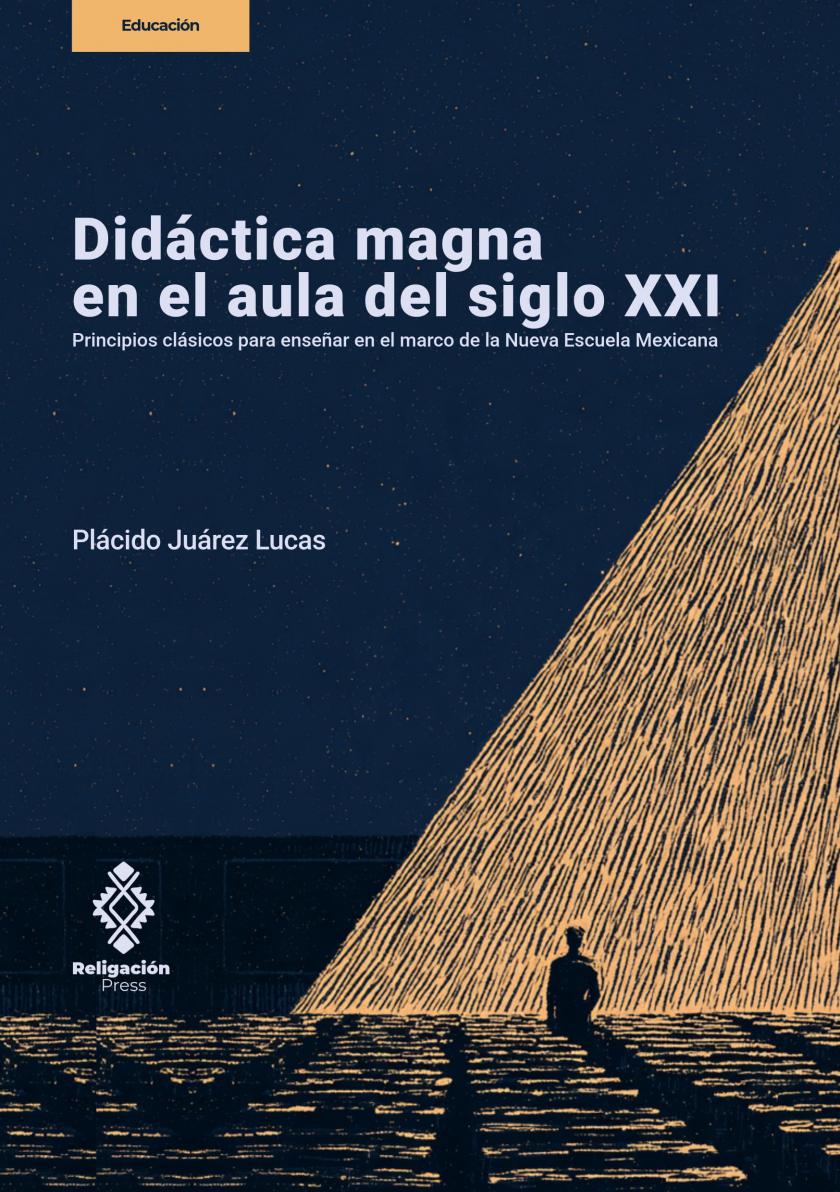
Didactica Magna in the 21st-Century Classroom. Classical Principles for Teaching within the Framework of the New Mexican School
Keywords:
Didactica Magna, Comenius, New Mexican School, pedagogical authority, memory and learning.Synopsis
This book proposes a contemporary rereading of classical didactics to strengthen teaching within the framework of the Nueva Escuela Mexicana. Against pedagogical fashions and superficial innovations, it reclaims enduring principles: teaching everyone, progressing from simple to complex, starting from experience, organizing the classroom, modeling thought, and consolidating memory through reflective practice. It defends the teacher’s legitimate pedagogical authority, the well-structured lecture, handwriting, meaningful dictation, and the chalkboard as cognitive tools. It articulates tradition and change with professional judgment and community sensitivity, offering guidelines for planning coherent sequences, conducting formative assessment, and avoiding innovations that weaken foundational learning. It is an invitation to teach with foundation, humanity, and context.
Downloads
Download data is not yet available.
References
Abbagnano, N., & Visalberghi, A. (1992). Historia de la pedagogía. Fondo de Cultura Económica.
Ainscow, M. (2005). Developing inclusive education systems: What are the levers for change? Journal of Educational Change, 6(2), 109–124. https://doi.org/10.1007/s10833-005-1298-4
Anderson, J. R. (2000). Learning and memory: An integrated approach. John Wiley & Sons.
Arendt, H. (1961). Between past and future: Six exercises in political thought. Viking Press.
Ausubel, D. P. (1960). The use of advanced organizers in the learning and retention of meaningful verbal material. Journal of Educational Psychology, 51(5), 267–272. https://doi.org/10.1037/h0046669
Ausubel, D. P. (1968). Educational psychology: A cognitive view. Holt, Rinehart and Winston.
Ausubel, D. P. (2002). Adquisición y retención del conocimiento: Una perspectiva cognitiva. Paidós.
Ausubel, D. P., Novak, J. D., & Hanesian, H. (1983). Psicología educativa: Un punto de vista cognoscitivo. Trillas.
Baddeley, A. D. (2000). The episodic buffer: A new component of working memory? Trends in Cognitive Sciences, 4(11), 417–423. https://doi.org/10.1016/S1364-6613(00)01538-2
Baddeley, A. D. (2012). Working memory: Theories, models, and controversies. Annual Review of Psychology, 63, 1–29. https://doi.org/10.1146/annurev-psych-120710-100422
Baddeley, A. D., & Hitch, G. (1974). Working memory. En G. H. Bower, (ed.). The psychology of learning and motivation (pp. 47–89). Academic Press.
Bandura, A. (1997). Self-efficacy: The exercise of control. W. H. Freeman.
Barrett, P., Zhang, Y., Davies, F., & Barrett, L. (2015). Clever classrooms: Summary report of the HEAD project. University of Salford. https://doi.org/10.13140/RG.2.1.4707.3520
Bartlett, F. C. (1932). Remember: A study in experimental and social psychology. Cambridge University Press.
Beijaard, D., Meijer, P. C., & Verloop, N. (2004). Reconsidering research on teachers’ professional identity. Teaching and Teacher Education, 20(2), 107–128. https://doi.org/10.1016/j.tate.2003.07.001
Berliner, D. C. (1990). What’s all the fuss about instructional time? En M. Ben-Peretz, & R. Bromme, (eds.). The nature of time in schools (pp. 3–35). Teachers College Press.
Biesta, G. J. J. (2014). The beautiful risk of education. Paradigm Publishers.
Bjork, E. L., Bjork, R. A., & otros colaboradores. (2013). Making things hard on yourself, but in a good way: Creating desirable difficulties to enhance learning. En M. A. Gernsbacher, & J. Pomerantz, (eds.). Psychology and the real world: Essays illustrating fundamental contributions to society (pp. 59–68). Worth Publishers.
Bjork, R. A. (2011). On the symbiosis of remembering, forgetting, and learning. En A. S. Benjamin, (ed.). Successful remembering and successful forgetting: A festschrift in honor of Robert A. Bjork (pp. 1–22). Psychology Press.
Black, P., & Wiliam, D. (1998a). Assessment and classroom learning. Assessment in Education: Principles, Policy & Practice, 5(1), 7–74. https://doi.org/10.1080/0969595980050102
Black, P., & Wiliam, D. (1998b). Inside the black box: Raising standards through classroom assessment. Phi Delta Kappan, 80(2), 139–148.
Bourdieu, P., & Passeron, J. C. (2001). La reproducción: Elementos para una teoría del sistema de enseñanza. Popular.
Bowen, J. (1981). A history of western education: Vol. 2. Civilization of Europe. Methuen.
Bradbury, N. A. (2016). Attention span during lectures: 8 seconds, 10 minutes, or more? Advances in Physiology Education, 40(4), 509–513. https://doi.org/10.1152/advan.00109.2016
Bransford, J. D., Brown, A. L., & Cocking, R. R. (2000). How people learn: Brain, mind, experience, and school. National Academy Press.
Bruner, J. (1988). Desarrollo cognitivo y educación. Morata.
Bruner, J. (1990). Acts of meaning. Harvard University Press.
Bruner, J. (2001). El proceso de la educación. Unión Tipográfica Editorial Hispanoamericanas.
Bruner, J. (2003). La fábrica de historias: Derecho, literatura, vida. Fondo de Cultura Económica.
Bruner, J. S. (1960). The process of education. Harvard University Press.
Bruner, J. S. (1966). Toward a theory of instruction. Harvard University Press.
Cámara de Diputados. (2019). Ley General de Educación. Diario Oficial de la Federación.
Carbonneau, K. J., Marley, S. C., & Selig, J. P. (2013). A meta-analysis of the efficacy of teaching mathematics with concrete manipulatives. Journal of Educational Psychology, 105(2), 380–400. https://doi.org/10.1037/a0031084
Carr, W., & Kemmis, S. (1988). Teoría crítica de la enseñanza: La investigación-acción en la formación del profesorado. Martínez Roca.
Cassany, D. (1989). Describir el escribir: Cómo se aprende a escribir. Paidós.
Cassany, D., Luna, M., & Sanz, G. (1994). Enseñar lengua. Graó.
CAST. (2018). Universal Design for Learning guidelines version 2.2. http://udlguidelines.cast.org
Cepeda, N. J., Pashler, H., Vul, E., Wixted, J. T., & Rohrer, D. (2006). Distributed practice in verbal recall tasks: A review and quantitative synthesis. Psychological Bulletin, 132(3), 354–380. https://doi.org/10.1037/0033-2909.132.3.354
Chevallard, Y. (1991). La transposición didáctica: Del saber sabio al saber enseñado. Aique.
Christodoulou, D. (2014). Seven myths about education. Routledge.
Collins, A., Brown, J. S., & Newman, S. E. (1989). Cognitive apprenticeship: Teaching the crafts of reading, writing, and mathematics. En L. B. Resnick, (ed.). Knowing, learning, and instruction: Essays in honor of Robert Glaser (pp. 453–494). Lawrence Erlbaum Associates.
Comenio, J. A. (1968). Orbis Sensualium Pictus. Sydney University Press.
Comenio, J. A. (1986). Didáctica Magna. Akal.
Comenio, J. A. (1992). Panegersia. Academia.
Comenio, J. A. (2012). Didáctica Magna. Porrúa.
Comenio, J. A. (2020). Orbis Sensualium Pictus. Facsímile Editorial.
Cowan, N. (2001). The magical number 4 in short-term memory: A reconsideration of mental storage capacity. Behavioral and Brain Sciences, 24(1), 87–114. https://doi.org/10.1017/S0140525X01003922
Csikszentmihalyi, M. (1990). Flow: The psychology of optimal experience. Harper & Row.
Cuban, L. (2001). Oversold and underused: Computers in the classroom. Harvard University Press.
Deci, E. L., & Ryan, R. M. (1985). Intrinsic motivation and self-determination in human behavior. Plenum.
Dehaene, S. (2020). How we learn: Why do brains learn better than any machine... for now. Viking.
Dewey, J. (1902). The child and the curriculum. University of Chicago Press.
Dewey, J. (1938). Experience and education. Macmillan.
Dewey, J. (2004a). Democracia y educación. Morata.
Dewey, J. (2004b). Experiencia y educación. Biblioteca Nueva.
Diamond, A. (2013). Executive functions. Annual Review of Psychology, 64, 135–168. https://doi.org/10.1146/annurev-psych-113011-143750
Díaz Barriga Arceo, F. (2006). Enseñanza situada: Vínculo entre la escuela y la vida. McGraw-Hill.
Díaz Barriga Arceo, F., & Hernández Rojas, G. (2010). Estrategias docentes para un aprendizaje significativo: Una interpretación constructivista. McGraw-Hill.
Díaz Barriga, Á. (2006). El enfoque de competencias en la educación: ¿Una alternativa o un disfraz de cambio? Perfiles Educativos, 28(111), 7–36.
Dunlosky, J., Rawson, K. A., Marsh, E. J., Nathan, M. J., & Willingham, D. T. (2013). Improving students’ learning with effective learning techniques: Promising directions from cognitive and educational psychology. Psychological Science in the Public Interest, 14(1), 4–58. https://doi.org/10.1177/1529100612453266
Ebbinghaus, H. (1964). Memory: A contribution to experimental psychology. Dover.
Elboj, C., Puigdellívol, I., Soler, M., & Valls, R. (2002). Comunidades de aprendizaje: Transformar la educación. Graó.
Elliot, J. (1993). El cambio educativo desde la investigación-acción. Morata.
Ericsson, K. A., Krampe, R. T., & Tesch-Römer, C. (1993). The role of deliberate practice in the acquisition of expert performance. Psychological Review, 100(3), 363–406. https://doi.org/10.1037/0033-295X.100.3.363
Fairclough, N. (2003). Analysing discourse: Textual analysis for social research. Routledge.
Ferreiro, E., & Teberosky, A. (1979). Los sistemas de escritura en el desarrollo del niño. Siglo XXI.
Fisher, D., & Frey, N. (2014). Better learning through structured teaching: A framework for the gradual release of responsibility. ASCD.
Foucault, M. (2002). Vigilar y castigar: Nacimiento de la prisión. Siglo XXI.
Freiberg, H. J., & Lamb, S. M. (2009). Dimensions of person-centered classroom management. Theory Into Practice, 48(2), 99–105. https://doi.org/10.1080/00405840902776228
Freinet, C. (1972). Por una escuela del pueblo. Fontanella.
Freire, P. (1970). Pedagogía del oprimido. Siglo XXI.
Freire, P. (2005). Pedagogía del oprimido. Siglo XXI.
Fuentes Molinar, O. (2013). La educación pública en México: Compromiso con la equidad. Siglo XXI Editores.
Gagné, R. M., Briggs, L. J., & Wager, W. W. (1992). Principles of instructional design. Harcourt Brace Jovanovich.
Gentner, D., & Markman, A. B. (1997). Structure mapping in analogy and similarity. American Psychologist, 52(1), 45–56. https://doi.org/10.1037/0003-066X.52.1.45
Giroux, H. A. (1988). Teachers as intellectuals: Toward a critical pedagogy of learning. Bergin & Garvey.
Guevara Niebla, G. (2012). La catástrofe silenciosa. Fondo de Cultura Económica.
Hargreaves, A., & Fullan, M. (2014). Capital profesional: Transformar la enseñanza en cada escuela. Morata.
Harlen, W. (Ed.). (2013). Inquiry-based learning in science and mathematics. Academy of Finland.
Hattie, J. (2009). Visible learning: A synthesis of over 800 meta-analyses relating to achievement. Routledge.
Hiebert, J., & Lefevre, P. (1986). Conceptual and procedural knowledge in mathematics: An introductory analysis. En J. Hiebert, (ed.). Conceptual and procedural knowledge: The case of mathematics (pp. 1–27). Lawrence Erlbaum.
Hodson, D. (1994). Hacia un enfoque más crítico del trabajo de laboratorio. Enseñanza de las Ciencias, 12(3), 299–313.
Hymes, D. (1972). On communicative competence. En J. B. Pride, & J. Holmes, (eds.). Sociolinguistics (pp. 269–293). Penguin.
Immordino-Yang, M. H., & Damasio, A. (2007). We feel, therefore, we learn: The relevance of affective and social neuroscience to education. Mind, Brain, and Education, 1(1), 3–10. https://doi.org/10.1111/j.1751-228X.2007.00004.x
Instituto Nacional de los Pueblos Indígenas. (2021). Atlas de los pueblos indígenas de México. https://atlas.inpi.gob.mx
Instituto Nacional para la Evaluación de la Educación. (2019). Panorama educativo de México 2018: Indicadores del sistema educativo nacional. INEE.
James, K. H., & Engelhardt, L. (2012). The effects of handwriting experience on functional brain development in pre-literate children. Trends in Neuroscience and Education, 1(1), 32–42.
Kamii, C. (2000). Young children reinvent arithmetic: Implications of Piaget’s theory. Teachers College Press.
Karpicke, J. D., & Roediger, H. L. (2008). The critical importance of retrieval for learning. Science, 319(5865), 966–968. https://doi.org/10.1126/science.1152408
King, A. (1993). From sage on the stage to guide on the side. College Teaching, 41(1), 30–35. https://doi.org/10.1080/87567555.1993.9926781
Kirschner, P. A., Sweller, J., & Clark, R. E. (2006). Why minimal guidance during instruction does not work: An analysis of the failure of constructivist, discovery, problem-based, experiential, and inquiry-based teaching. Educational Psychologist, 41(2), 75–86. https://doi.org/10.1207/s15326985ep4102_1
Klein, J. T. (1990). Interdisciplinarity: History, theory, and practice. Wayne State University Press.
Kline, M. (1973). Why Johnny can’t add: The failure of the new math. St. Martin’s Press.
Kornell, N., & Bjork, R. A. (2008). Learning concepts and categories: Is spacing the enemy of induction? Psychological Science, 19(6), 585–592. https://doi.org/10.1111/j.1467-9280.2008.02127.x
Langer, E. J. (1989). Mindfulness. Addison-Wesley.
Latapí Sarre, P. (2003). El debate sobre los valores en la escuela mexicana. Fondo de Cultura Económica.
Latapí Sarre, P. (2009). El derecho a la educación: Su alcance, exigibilidad y relevancia para la política educativa. Revista Mexicana de Investigación Educativa, 14(40), 255–287.
Leibniz, G. W. (1949). Nuevos ensayos sobre el entendimiento humano. Aguilar.
Lemke, J. L. (1990). Talking science: Language, learning, and values. Ablex.
Maslach, C., & Leiter, M. P. (1997). The truth about burnout. Jossey-Bass.
Mayer, R. E. (2009). Multimedia learning. Cambridge University Press.
Meirieu, P. (2001). La opción de educar: Ética y pedagogía. Octaedro.
Merrill, M. D. (2002). First principles of instruction. Educational Technology Research and Development, 50(3), 43–59. https://doi.org/10.1007/BF02505024
Miller, G. A. (1956). The magical number seven, plus or minus two: Some limits on our capacity for processing information. Psychological Review, 63(2), 81–97. https://doi.org/10.1037/h0043158
Moguel Viveros, J. (2009). La enseñanza en escuelas multigrado. En E. Sandoval Flores, (ed.). La escuela multigrado en México: Aprendizajes y desafíos (pp. 120–145). SEP-Universidad Pedagógica Nacional.
Mueller, P. A., & Oppenheimer, D. M. (2014). The pen is mightier than the keyboard: Advantages of longhand over laptop note taking. Psychological Science, 25(6), 1159–1168. https://doi.org/10.1177/0956797614524581
Murphy, J. (1995). Comenio y la educación. Perspectivas: Revista Trimestral de Educación Comparada, 25(3–4), 473–490.
Nestojko, J. F., Bui, D. C., Kornell, N., & Bjork, E. L. (2014). Expecting to teach enhances learning and organization of knowledge in free recall of text passages. Memory & Cognition, 42(7), 1038–1048. https://doi.org/10.3758/s13421-014-0416-z
Novak, J. D., & Gowin, D. B. (1984). Learning how to learn. Cambridge University Press.
Nussbaum, M. C. (2010). Sin fines de lucro: Por qué la democracia necesita de las humanidades. Katz.
Ornelas, C. (1995). El sistema educativo mexicano: La transición de fin de siglo. Fondo de Cultura Económica.
Ornelas, C. (2023). La Nueva Escuela Mexicana: Entre el discurso y la práctica. Fondo de Cultura Económica.
Paris, S. G., Lipson, M. Y., & Wixson, K. K. (1983). Becoming a strategic reader. Contemporary Educational Psychology, 8(3), 293–316. https://doi.org/10.1016/0361-476X(83)90018-8
Perkins, D. N., & Salomon, G. (1988). Teaching for transfer. Educational Leadership, 46(1), 22–32.
Piaget, J. (1932). El criterio moral en el niño. Fontanella.
Piaget, J. (1970). Piaget’s theory. En P. H. Mussen, (ed.). Carmichael’s manual of child psychology (pp. 703–732). Wiley.
Piaget, J. (2001). Psicología y pedagogía. Ariel.
Pimsleur, P. (1967). A memory schedule. Modern Language Journal, 51(2), 73–75. https://doi.org/10.2307/322812
Ramírez Castañeda, R. (1964). La escuela rural mexicana. SEP.
Ravitch, D. (2000). Left back: A century of battles over school reform. Simon & Schuster.
Recht, D. R., & Leslie, L. (1988). Effect of prior knowledge on good and poor readers’ memory of text. Journal of Educational Psychology, 80(1), 16–20. https://doi.org/10.1037/0022-0663.80.1.16
Ritchhart, R., Church, M., & Morrison, K. (2011). Making thinking visible: How to promote engagement, understanding, and independence for all learners. Jossey-Bass.
Rivera Ferreiro, L. (2020). Pedagogía y comunidad en la Nueva Escuela Mexicana. Universidad Pedagógica Nacional.
Rockwell, E. (2009). La experiencia etnográfica: Historia y cultura en los procesos educativos. Paidós.
Roediger, H. L., & Karpicke, J. D. (2006). Test-enhanced learning: Taking memory tests improves long-term retention. Psychological Science, 17(3), 249–255. https://doi.org/10.1111/j.1467-9280.2006.01693.x
Roediger, H. L., & Pyc, M. A. (2012). Inexpensive techniques to improve education: Applying cognitive psychology to enhance educational practice. Journal of Applied Research in Memory and Cognition, 1(4), 242–248. https://doi.org/10.1016/j.jarmac.2012.09.002
Röer, J. P., Bell, R., & Buchner, A. (2013). Object-based set shifting is unaffected by the irrelevant speech effect. Journal of Cognitive Psychology, 25(6), 645–653. https://doi.org/10.1080/20445911.2013.814683
Rohrer, D., & Taylor, K. (2006). The effects of overlearning and distributed practise on the retention of mathematics knowledge. Applied Cognitive Psychology, 20(9), 1209–1224. https://doi.org/10.1002/acp.1266
Rohrer, D., & Taylor, K. (2007). The shuffling of mathematics problems improves learning. Instructional Science, 35(6), 481–498. https://doi.org/10.1007/s11251-007-9015-8
Rosenshine, B. (2012). Principles of instruction: Research-based strategies that all teachers should know. American Educator, 36(1), 12–19.
Rosenthal, R., & Jacobson, L. (1980). Pigmalión en la escuela: Expectativas del maestro y desarrollo intelectual del alumno. Marova.
Rýdl, K. (2007). Jan Amos Comenius: El padre de la educación moderna. Educación y Pedagogía, 19(47), 15–28.
Sandoval Flores, E. (2009). La escuela multigrado en México: Aprendizajes y desafíos. SEP-Universidad Pedagógica Nacional.
Savater, F. (1997). El valor de educar. Ariel.
Schmelkes del Valle, S. (2019). Equidad y calidad educativa: Un balance necesario. Revista Mexicana de Investigación Educativa, 24(82), 39–58.
Schmelkes, S. (1994). Hacia una mejor calidad de nuestras escuelas. Interamer/OEA.
Secretaría de Educación Pública. (2004). Programa de educación preescolar 2004. SEP.
Secretaría de Educación Pública. (2019). Programa Escolar de Mejora Continua: Orientaciones generales. SEP.
Secretaría de Educación Pública. (2022). Plan de estudios de la educación básica 2022. https://www.sep.gob.mx/plan-de-estudios-2022
Seligman, M. E. P. (2011). Flourish: A visionary new understanding of happiness and well-being. Free Press.
Shaywitz, S. E., & Shaywitz, B. A. (2020). Dyslexia: A gift or a challenge? American Journal of Psychiatry, 177(6), 470–472. https://doi.org/10.1176/appi.ajp.2020.20030267
Simonton, D. K. (2004). Creativity in science: Chance, logic, genius, and zeitgeist. Cambridge University Press.
Sinclair, J. M., & Coulthard, M. (1975). Towards an analysis of discourse: The English used by teachers and pupils. Oxford University Press.
Stake, R. E. (1995). The art of case study research. SAGE.
Steiner, G. (2004). Lecciones de los maestros. Siruela.
Sweller, J. (1988). Cognitive load during problem solving: Effects on learning. Cognitive Science, 12(2), 257–285. https://doi.org/10.1207/s15516709cog1202_4
Sweller, J. (2011). Cognitive load theory. En J. P. Mestre, & B. H. Ross, (eds.). The psychology of learning and motivation (pp. 37–76). Academic Press.
Tomlinson, C. A. (2001). How to differentiate instruction in mixed-ability classrooms. ASCD.
Tyler, R. W. (1949). Basic principles of curriculum and instruction. University of Chicago Press.
Vygotski, L. S. (1979). El desarrollo de los procesos psicológicos superiores. Crítica.
Vygotsky, L. S. (1978). Mind in society: The development of higher psychological processes. Harvard University Press.
Wieman, C., Adams, W., Loeblein, P., & Perkins, K. (2010). Teaching physics using PhET simulations. The Physics Teacher, 48(4), 225–227. https://doi.org/10.1119/1.3361987
Willingham, D. T. (2009). Why don’t students like school? A cognitive scientist answers questions about how the mind works and what it means for the classroom. Jossey-Bass.
Zimmerman, B. J. (2002). Becoming a self-regulated learner: An overview. Theory Into Practice, 41(2), 64–70. https://doi.org/10.1207/s15430421tip4102_2
Published
July 2, 2026
Series
Copyright (c) 2026 Plácido Juárez Lucas

Details about the available publication format: PDF
PDF
ISBN-13 (15)
978-9942-594-82-2
Publication date (01)
2026-07-02