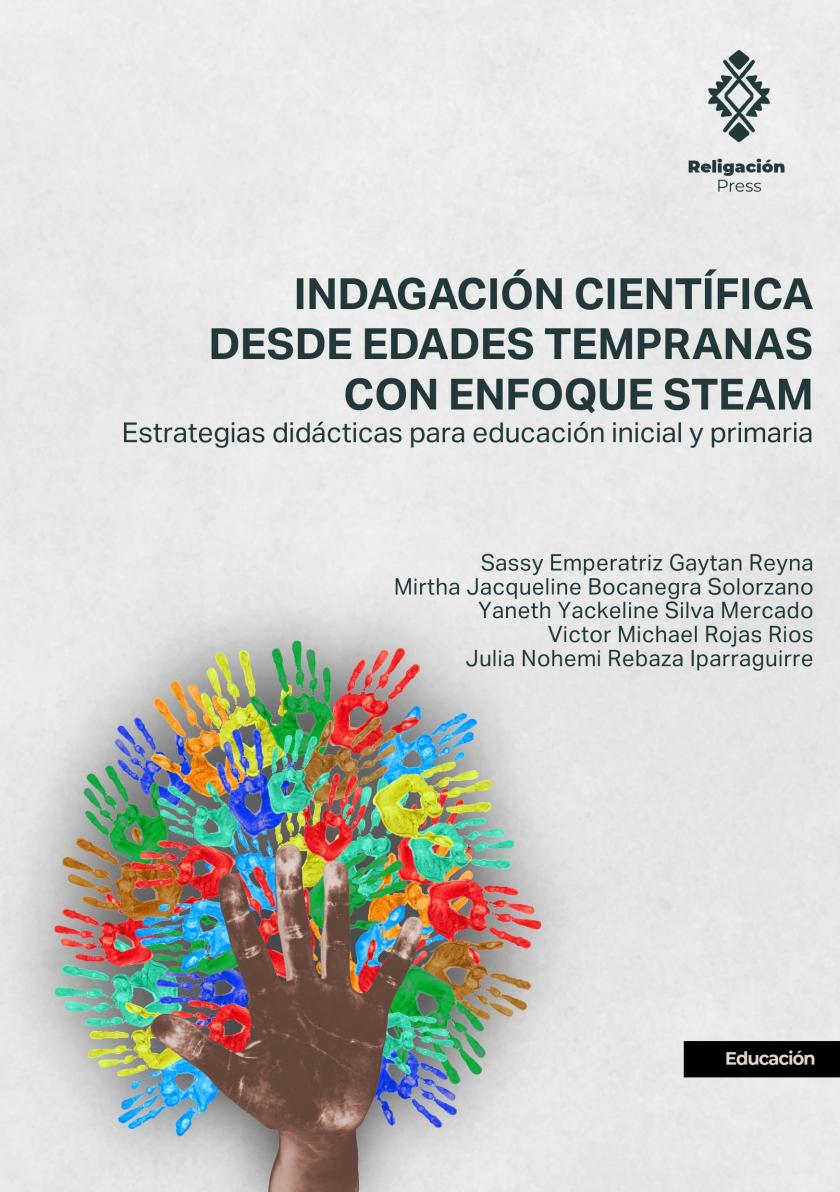
Scientific Inquiry from Early Ages with a STEAM Approach. Didactic Strategies for Early Childhood and Primary Education
Keywords:
scientific inquiry, STEAM approach, school garden, early childhood education, experiential learning.Synopsis
This book invites readers to rediscover science through hands-on experience, play, and direct exploration of the environment. Driven by children's innate curiosity, it proposes that young learners observe, question, experiment, and share their findings, thereby transforming learning into a living adventure. In contrast to fragmented science instruction, the work advocates for the STEAM approach and positions the school garden as an ideal setting—a space where inquiry, critical thinking, environmental responsibility, and collaborative work take root. The teacher, acting as a mediator, orchestrates questions, observations, and records, weaving together meaningful learning experiences. In essence, this book demonstrates that the school garden, when integrated with STEAM, is far more than a plot of land: it is an open classroom where science is sown, cultivated, and blossoms at every stage of early and primary education.
Downloads
Download data is not yet available.
References
Ahmadpour, N., & Mujembari, A. K. (2015). The impact of Montessori teaching method on IQ levels of 5-year old children. Procedia - Social and Behavioral Sciences, 205, 122–127. https://doi.org/10.1016/j.sbspro.2015.09.037
Angel Ortiz-Esparza, M., Cardona Reyes, H., Mamani-Calcina, J., & Rondon, D. (2025). Incorporating STEAM strategies to develop scientific problem-solving skills in infants. CLEI Electronic Journal, 28(4).
Awang, Z., Yakob, N., Hamzah, A., & Talling, M. M. (2020). Exploring STEAM teaching in preschool using Fred Rogers approach. International Journal of Evaluation and Research in Education, 9(4), 1071–1078. https://doi.org/10.11591/ijere.v9i4.20674
Balsera, P. D., Garmendia, L. M. N., & Urdin, J. A. (2015). Las políticas supranacionales de UNICEF, infancia y educación. Bordón, 67(1), 25–38. https://doi.org/10.13042/Bordon.2015.67102
Bartoszeck, A. B., Vandrovieski, W., Tratch, V., Czelusniak, F., & Tunnicliffe, S. D. (2018). What do Brazilian school children know about birds in their country? European Journal of Educational Research, 7(3), 485–499. https://doi.org/10.12973/eu-jer.7.3.485
Bayles, J., Peterson, A. D., Jilcott Pitts, S., Bian, H., Goodell, L. S., Burkholder, S., Hegde, A. V., & Stage, V. C. (2021). Food-based science, technology, engineering, arts, and mathematics (STEAM) learning activities may reduce decline in preschoolers’ skin carotenoid status. Journal of Nutrition Education and Behavior, 53(4), 343–351. https://doi.org/10.1016/j.jneb.2020.10.017
Capillo Martel, M., & Mauricio Salazar, M. J. (2019). Método Montessori para el desarrollo del concepto número en niños de 6 años. Universidad Antonio Ruiz de Montoya.
Courtier, P., Gardes, M. L., Van der Henst, J. B., Noveck, I. A., Croset, M. C., Epinat-Duclos, J., Léone, J., & Prado, J. (2021). Effects of Montessori education on the academic, cognitive, and social development of disadvantaged preschoolers: A randomized controlled study in the French public-school system. Child Development, 92(5), 2069–2088. https://doi.org/10.1111/cdev.13575
Dereli İman, E., Danişman, Ş., Akin Demircan, Z., & Yaya, D. (2019). The effect of the Montessori education method on pre-school children’s social competence–behaviour and emotion regulation skills. Early Child Development and Care, 189(9), 1494–1508. https://doi.org/10.1080/03004430.2017.1392943
Dong, C., Cao, S., & Li, H. (2020). Young children’s online learning during COVID-19 pandemic: Chinese parents’ beliefs and attitudes. Children and Youth Services Review, 118. https://doi.org/10.1016/j.childyouth.2020.105440
Erwin, E. J., Brotherson, M. J., Palmer, S. B., Cook, C. C., Weigel, C. J., & Summers, J. A. (2009). How to promote self-determination for young children with disabilities: Evidenced-based strategies for early childhood practitioners and families. Young Exceptional Children, 12(2), 27–37. https://doi.org/10.1177/1096250608329611
Eugenio-Gozalbo, M., Truchero, G. R., & Rapp, C. V. (2019). University gardens: Identifying learning dimensions as perceived by future teachers. Enseñanza de las Ciencias, 37(3), 111–127. https://doi.org/10.5565/rev/ensciencias.2657
Ewald, C. N., Adams, S. N., Yadav, P., Moon, K., Sah, A., Swain, D., & Kim, S. (2026). Hands-on lithography for PreK-5 students: Accessible art activity to learn semiconductor nanofabrication. Journal of Chemical Education, 103(3), 1323–1329. https://doi.org/10.1021/acs.jchemed.5c00938
Hayes, D., Contento, I. R., & Weekly, C. (2018). Position of the Academy of Nutrition and Dietetics, Society for Nutrition Education and Behavior, and School Nutrition Association: Comprehensive nutrition programs and services in schools. Journal of Nutrition Education and Behavior, 50(5), 425–431. https://doi.org/10.1016/j.jneb.2018.03.001
Hernández Sampieri, R. (2014). Metodología de la investigación. McGraw-Hill Education.
Hoyne, C., & Egan, S. M. (2022). ABCs and 123s: A large birth cohort study examining the role of the home learning environment in early cognitive development. Journal of Experimental Child Psychology, 221. https://doi.org/10.1016/j.jecp.2022.105424
Ingram, E., Hill, T. W., Harshbarger, D., & Keshwani, J. (2024). Improving elementary pre-service teachers’ science teaching self-efficacy through garden-based technology integration. Education Sciences, 14(65). https://doi.org/10.3390/educsci14010065
Ingram, E., & Keshwani, J. (2020). Nebraska school gardens and the potential for science, technology, engineering, and math learning. Journal of Extension, 58(6), 1–22. https://doi.org/10.34068/joe.58.06.14
Johnston, K., Kervin, L., & Wyeth, P. (2022). STEM, STEAM and makerspaces in early childhood: A scoping review. Sustainability, 14(13533). https://doi.org/10.3390/su142013533
Junge, K., Schmerse, D., Lankes, E. M., Carstensen, C. H., & Steffensky, M. (2021). How the home learning environment contributes to children’s early science knowledge—Associations with parental characteristics and science-related activities. Early Childhood Research Quarterly, 56, 294–305. https://doi.org/10.1016/j.ecresq.2021.04.004
Kao, C. P., Lin, K. Y., & Williams, P. J. (2025). The influence of STEAM-based block play on creative imagination and performance in preschool children: A latent growth curve model. International Journal of Technology and Design Education, 36, 465–482. https://doi.org/10.1007/s10798-025-10014-1
Lillard, A. S. (2012). Preschool children’s development in classic Montessori, supplemented Montessori, and conventional programs. Journal of School Psychology, 50(3), 379–401. https://doi.org/10.1016/j.jsp.2012.01.001
Marshall, C. (2017). Montessori education: A review of the evidence base. npj Science of Learning, 2(1), 1–9. https://doi.org/10.1038/s41539-017-0012-7
Oryan, D., Menahem, E., Ron, L., Doron, G., & Maman, S. (2026). The Ramon Space Race program: Empowering teachers for early childhood space education. Acta Astronautica, 240, 408–416. https://doi.org/10.1016/j.actaastro.2025.11.083
Prada Núñez, R., Peñaloza Tarazona, M. E., & Rodríguez Moreno, J. (2024). Trends and challenges of integrating the STEAM approach in education: A Scopus literature review. Data and Metadata, 3(424). https://doi.org/10.56294/dm2024.424
Pransiska, R., Rozimela, Y., & Hadiyanto, H. (2025). Understanding kindergarten teachers’ readiness and acceptance of STEAM-oriented interactive e-books for English vocabulary instruction. International Journal of Learning, Teaching and Educational Research, 24(3), 500–516. https://doi.org/10.26803/ijlter.24.3.24
Stage, V. C., Dixon, J. B., Grist, P., Wu, Q., Hegde, A. V., Lee, T. D., Lundquist, R., & Goodell, L. S. (2025). A food-based science, technology, engineering, arts, and mathematics learning program may improve preschool children’s science knowledge and language skills in rural North Carolina. Nutrients, 17(1523), 1–22. https://doi.org/10.3390/nu17091523
Stage, V. C., Dixon, J. B., Lundquist, R., Wu, Q., Hegde, A. V., Lee, T. D., Grist, P., & Goodell, L. S. (2026). More PEAS please! Implementation methodology of a preschool program promoting healthy eating, science, and language. Journal of Nutrition Education and Behavior, 58(6), 603–615. https://doi.org/10.1016/j.jneb.2026.01.006
Super, L., Qin, J., Zhang, L., Chhina, N., Athwal, E., Pryde, S., & Singh, S. (2025). Exploring scientific complexity with authenticity and inclusion: New curricula and assessment materials for phytobiome STEAM kits. Natural Sciences Education, 54(2). https://doi.org/10.1002/nse2.70022
Trina, N. A., Monsur, M., Cosco, N., Loon, L., Shine, S., & Mastergeorge, A. (2025). Rethinking traditional playgrounds: Temporary landscape interventions to advance informal early STEAM learning in outdoors. Education Sciences, 15(8). https://doi.org/10.3390/educsci15080952
Trina, N. A., Monsur, M., Cosco, N., Shine, S., Loon, L., & Mastergeorge, A. (2024). How do nature-based outdoor learning environments affect preschoolers’ STEAM concept formation? A scoping review. Education Sciences, 14(627), 1–21. https://doi.org/10.3390/educsci14060627
Trina, N. A., Monsur, M., Cosco, N., Shine, S., Loon, L., & Mastergeorge, A. (2025). Tools for assessing the STEAM learning affordances and quality of outdoor learning environments of childcare centers: A systematic review. Early Childhood Education Journal, 54, 1091–1107. https://doi.org/10.1007/s10643-025-01911-0
Veziroglu-Celik, M., Ozkaya, S., Kacar, G., & Senturk, Z. E. (2025). STEAM in early childhood: An analysis towards teachers’ and children’s perspectives. Early Childhood Education Journal, 54, 1027–1039. https://doi.org/10.1007/s10643-025-01897-9
Villarreal Ghellinaza, R. H. (2013). Espacios educativos: Para niños y niñas de 0 a 3 años. Guía de orientación. Ministerio de educación.
Woo, S. (2014). Creating an amazing Montessori toddler home environment. Montessori Life, 26(2), 54–59.
Wu-Rorrer, R., & Mecca, P. (2025). STEM environments in secondary education sustainability programs: A case study on the application of AgroLab framework. International Journal of Sustainability in Economic, Social, and Cultural Context, 22(1), 23–40. https://doi.org/10.18848/2325-1115/CGP/v22i01/23-40
Xu, J., Gao, X., Lin, T., Wang, W., Xu, H., Xu, Y., Wang, X., Cheng, X., Chen, Z., Tan, T., Qi, H., Wang, Y., Hong, M., & Liu, S. (2025). Horticulture in education: A comprehensive insight into school gardening. Future in Educational Research, 3(1), 28–47. https://doi.org/10.1002/fer3.62
Zhan, Y., Wu, Y., Liu, X., & Zhao, L. (2025). Characterizing social problem-solving skills in STEAM activities among preschool children enacting different social positions. Thinking Skills and Creativity, 58(101931), 1–20. https://doi.org/10.1016/j.tsc.2025.101931
Published
July 20, 2026
Series
Copyright (c) 2026 Sassy Emperatriz Gaytan Reyna, Mirtha Jacqueline Bocanegra Solorzano, Yaneth Yackeline Silva Mercado, Victor Michael Rojas Rios, Julia Nohemi Rebaza Iparraguirre

Details about the available publication format: PDF
PDF
ISBN-13 (15)
978-9942-594-90-7
Publication date (01)
2026-07-20