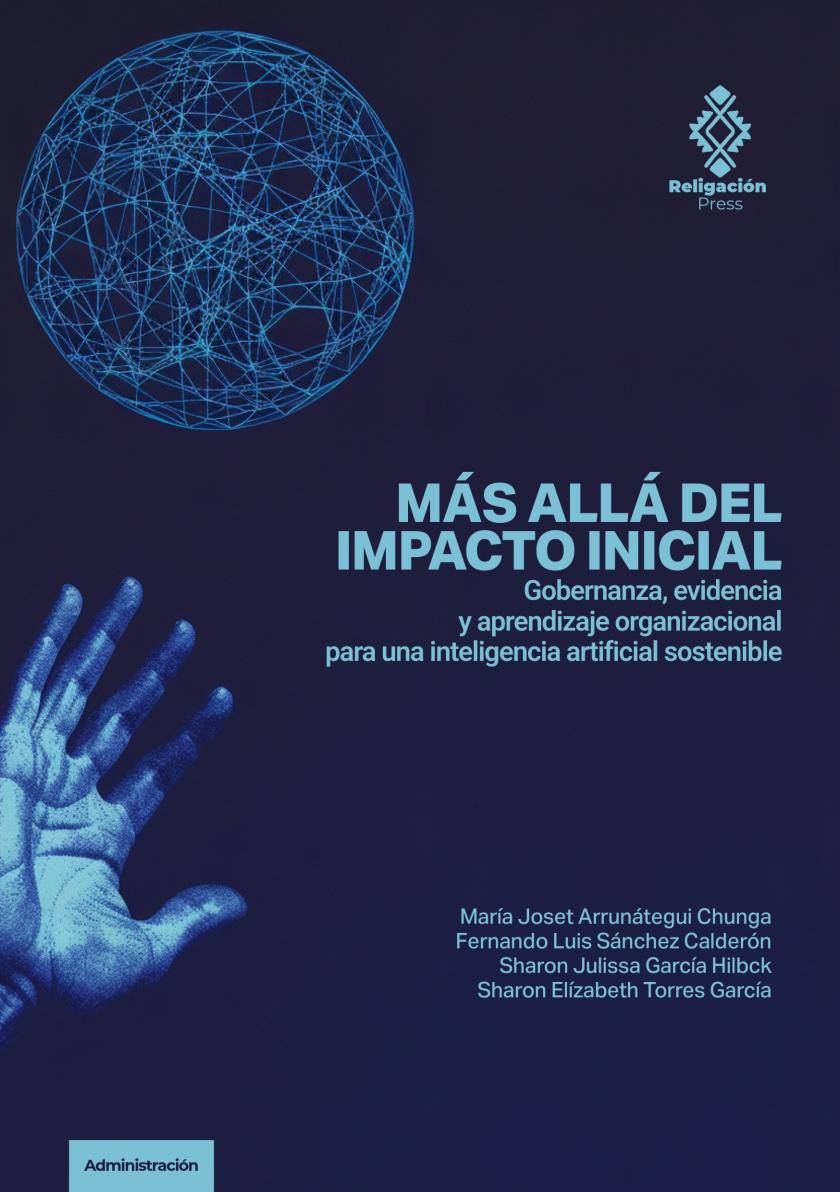
Beyond the initial impact. Governance, evidence, and organizational learning for sustainable artificial intelligence
Keywords:
Artificial intelligence, organizational capability, internal control, evidence, responsible adoption.Synopsis
This book offers a different perspective on artificial intelligence in organizations: it does not ask what technology can do, but under what conditions its use improves a decision without undermining control. Throughout its pages, it traverses administrative management, accounting, auditing, financial planning, treasury, credit, fraud, and governance, and shows that capability does not arise from the tool but from the articulation of process, data, people, responsibility, and evidence. Against the enthusiasm of demonstration, it offers a sober discipline: inventory, baseline, reversible pilots, decision gates, and documented learning. It does not promise certainties or shortcuts. It proposes, instead, a structured conversation so that executives, accountants, auditors, and educators can distinguish between what the organization actually built and what it merely announced. A book for thinking about adoption with judgment and sustaining it with evidence.
Downloads
Download data is not yet available.
References
Banco de México. (2026). Reporte de estabilidad financiera: Junio de 2026. https://www.banxico.org.mx/publicaciones-y-prensa/reportes-sobre-el-sistema-financiero/
Bank for International Settlements. (2025). Governance of AI adoption in central banks. https://www.bis.org/publications/governance-ai-adoption-central-banks.pdf
Biblioteca del Congreso Nacional de Chile. (2024). Ley 21.719: Modifica la Ley N.º 19.628 sobre protección de la vida privada. https://www.bcn.cl/leychile
Comisión Económica para América Latina y el Caribe. (2026). Latin American Artificial Intelligence Index (ILIA) 2025: Key findings, applied artificial intelligence, and human talent. https://www.cepal.org/en/publications/86008-latin-american-artificial-intelligence-index-ilia-2025-key-findings-applied
Comisión para el Mercado Financiero. (2026, 19 de mayo). CMF publica Compendio Normativo aplicable a las Empresas de Auditoría Externa. https://www.cmfchile.cl/portal/prensa/625/w4-article-110558.html
Departamento Nacional de Planeación. (2025). Documento CONPES 4144: Política Nacional de Inteligencia Artificial. https://colaboracion.dnp.co/CDT/Conpes/Econ%C3%B3micos/4144.pdf
Gerosa, M., & Hermansen, A. (2025). Economic and workforce impacts of AI in Latin America: A review of industry, academic, and open source evidence. Linux Foundation. https://www.linuxfoundation.org/hubfs/Research%20Reports/Economic_Workforce_Impacts_AI_LatAm_Report.pdf?hsLang=en
International Federation of Accountants. (2026). Artificial intelligence & accounting. https://www.ifac.org/knowledge-gateway/discussion/artificial-intelligence-accounting
International Organization for Standardization. (2023). ISO/IEC 42001:2023 Information technology—Artificial intelligence—Management system [Estándar internacional]. https://www.iso.org/standard/81230.html
National Institute of Standards and Technology. (2024). Artificial Intelligence Risk Management Framework: Generative Artificial Intelligence Profile (NIST AI 600-1). https://doi.org/10.6028/NIST.AI.600-1
Nubank. (2025). How Nubank uses transformers to model financial habits at scale. https://building.nubank.com/how-nubank-uses-transformers-to-model-financial-habits-at-scale/
Organisation for Economic Co-operation and Development. (2024). OECD AI Principles. https://www.oecd.org/en/topics/sub-issues/ai-principles.html
Presidencia del Consejo de Ministros. (2025). Decreto Supremo N.º 115-2025-PCM: Reglamento de la Ley N.º 31814. Diario Oficial El Peruano.
Santini-Rodríguez, F. J. (2026). Inteligencia artificial en la fiscalización gubernamental: avances, desafíos y perspectivas éticas desde una revisión sistemática. SciELO. http://ve.scielo.org/scielo.php?script=sci_arttext&pid=S2739-00632026000303108
Superintendencia de Sociedades. (2026). Política de aplicación y uso de inteligencia artificial (GIN-PO-005). https://www.supersociedades.gov.co/documents/107391/3463418/GIN-PO-005_Politica_Aplicacion_Uso_Inteligencia_Artificial.pdf
UNESCO. (2021). Recommendation on the ethics of artificial intelligence. https://www.unesco.org/en/artificial-intelligence/recommendation-ethics
World Economic Forum. (2026). Latin America in the intelligent age: A new path for growth. https://reports.weforum.org/docs/WEF_Latin_America_Intelligent_Age.pdf
Published
November 2, 2026
Series
Copyright (c) 2026 María Joset Arrunátegui Chunga, Fernando Luis Sánchez Calderón, Sharon Julissa García Hilbck, Sharon Elízabeth Torres García

Details about the available publication format: PDF
PDF
ISBN-13 (15)
978-9907-845-40-2
Publication date (01)
2026-11-02