
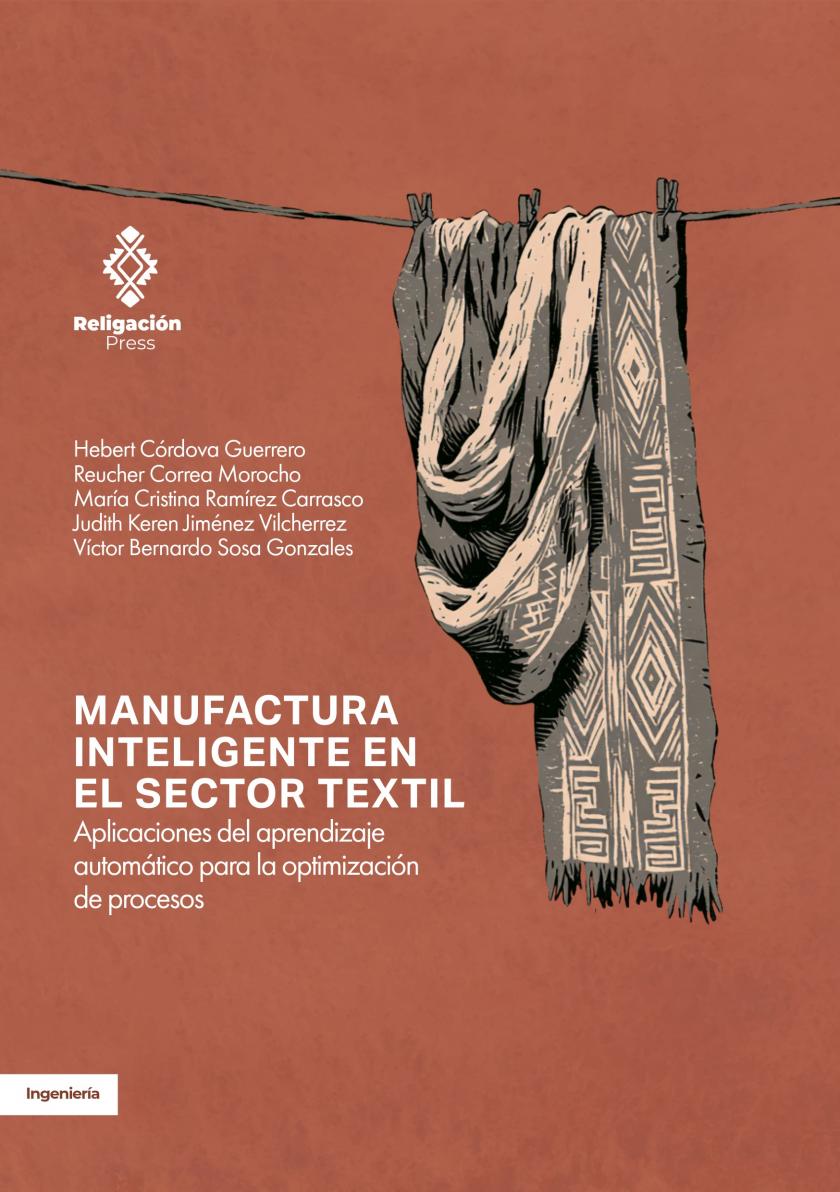
Manufatura inteligente no setor têxtil. Aplicações da aprendizagem de máquina para a otimização de processos
Palavras-chave:
Convencionalidade, Habeas Corpus, prisão preventiva, Tribunal Constitucional, liberdade.Sinopse
Esta pesquisa examina a influência do princípio da convencionalidade na jurisprudência do Tribunal Constitucional do Peru, centrando-se nas sentenças de Habeas Corpus sobre prisão preventiva. O estudo analisa como este princípio, que obriga a harmonizar o direito interno com os padrões interamericanos, é aplicado pelo tribunal para proteger a liberdade pessoal e a presunção de inocência. O trabalho argumenta que a incorporação efetiva desses padrões é crucial para evitar o uso excessivo da prisão preventiva, motivar devidamente as decisões judiciais e priorizar a liberdade como direito fundamental. Conclui-se que a convencionalidade fortalece a proteção dos direitos humanos no sistema de justiça peruano.
Downloads
Não há dados estatísticos.
Referências
Abdelrazek, A., Ayyad, A., & Hassanein, A. (2025). Deep learning for manufacturing process optimization. Journal of Industrial Engineering, 56(3), 112-128.
Ailisto, H., Mäntylä, M., & Seppänen, M. (2023). The impact of artificial intelligence on manufacturing value added. International Journal of Production Economics, 245, 108-125.
Ait Ben Hamou, A., Zufferey, N., & Glover, F. (2024). Optimizing production scheduling with LightGBM and machine learning. European Journal of Operational Research, 312(1), 45-62.
Alkhaleel, A. (2024). Pattern discovery in manufacturing data using unsupervised learning. Computers in Industry, 155, 104-118.
Altmann, J., & Becker, T. (2023). Trend analysis for quality improvement in textile production. Quality Engineering, 35(3), 456-472.
Alzubaidi, L., Zhang, J., & Humaidi, A. J. (2021). Review of deep learning: Concepts, CNN architectures, challenges, applications, future directions. Journal of Big Data, 8(1), 53-85.
Ani, E. N. (2024). Automated quality inspection in textile manufacturing. Textile Research Journal, 94(11-12), 1456-1472.
Ani, E. N., Ogunwande, O. S., & Adebayo, A. A. (2024). Root cause analysis in manufacturing quality control. International Journal of Production Research, 62(8), 2789-2806.
Anowar, F., Sadaoui, S., & Selim, B. (2021). Conceptual and empirical analysis of feature extraction algorithms for high-dimensional data. Expert Systems with Applications, 167, 114-134.
Antosz, K., & Machado, J. (2024). Convolutional neural networks for defect detection in manufacturing. Applied Soft Computing, 150, 111-128.
Arko, A., & Morrison, J. (2025). Unsupervised learning for process optimization in textile manufacturing. Journal of Manufacturing Systems, 74, 234-251.
Arista, R., García, P., & López, M. (2023). Ontology-based production planning for smart manufacturing. IEEE Access, 11, 45678-45695.
Asmelash, T., & Kumar, R. (2021). Predictive maintenance for textile machinery using machine learning. Journal of Textile Science, 56(4), 345-362.
Ayyalasomayajula, V., & Reddy, K. (2023). Reinforcement learning for industrial process control. Journal of Intelligent Manufacturing, 34(3), 1234-1252.
Azevedo, A., & Silva, R. (2022). Historical data integration in textile manufacturing. Computers in Industry, 138, 103-119.
Babu, A. R. (2025). Revolutionizing textile quality control through machine learning. Journal of Textile and Apparel Technology, 15(1), 45-67.
Bejani, M. M., & Ghatee, M. (2021). Challenges in predictive maintenance data balancing. IEEE Transactions on Industrial Informatics, 17(8), 5678-5689.
Bertolini, M., & Esposito, G. (2021). Inventory management in lean manufacturing environments. International Journal of Production Research, 59(15), 4567-4582.
Blies, M., & Schneider, T. (2025). Trial and error learning for textile drape simulation. Textile Research Journal, 95(3), 234-251.
Blondheim, E. (2022). Semantic defect classification in textile manufacturing. Journal of Visual Computing, 38(4), 567-582.
Bougie, P., & Tremblay, J. (2022). Reinforcement learning training in digital twins. Journal of Manufacturing Systems, 63, 123-138.
Carou, D., & Davim, J. P. (2022). Machine learning applications in industrial sustainability. Journal of Cleaner Production, 330, 129-145.
Chang, Y., & Liu, W. (2024). Parameter optimization in textile drying processes. Applied Thermal Engineering, 236, 121-138.
Chango Chango, D. A., Paredes Anchatipán, A. D., & Romero Bedón, F. R. (2024). Análisis del uso de machine learning para sistema de control predictivo a nivel industrial. Polo del Conocimiento, 9(7). https://doi.org/10.23857/pc.v9i7.7549
Chase, R. B., & Jacobs, F. R. (2018). Operations and supply chain management (15th ed.). McGraw-Hill Education.
Cheung, W., & Yang, H. (2023). Hidden pattern discovery in manufacturing quality data. Journal of Intelligent Manufacturing, 34(6), 2789-2804.
Ciancio, M., & D’Angelo, G. (2022). Predictive maintenance strategies for industrial machinery. Reliability Engineering & System Safety, 222, 108-125.
Córdova Guerrero, H. (2026). Efecto del aprendizaje automatico en los procesos de manufactura de la empresa Textil Amed Industry, Lima, Perú, 2025 [Tesis de maestría, Universidad Nacional de Piura].
Cui, Y., & Zhang, L. (2025). Attention mechanisms for textile defect detection. Computer Vision and Image Understanding, 240, 103-118.
Du, Y., & Wang, H. (2022). High-throughput screening using artificial intelligence. Advanced Intelligent Systems, 4(8), 210-228.
Dzulfikri, R., & Chen, Y. (2021). Deep metric learning for stamping tool condition diagnosis. Journal of Manufacturing Processes, 68, 234-251.
Elía, J., & Pagola, M. (2025). Clustering applications in textile production planning. Journal of Operations Management, 67(2), 123-140.
Elkateb, T., & Hassan, M. (2025). Feature selection and regularization in manufacturing data. Applied Soft Computing, 155, 111-128.
Elsayegh, H., & Hassaneen, A. (2024). Generative AI for textile design automation. Journal of Textile Design Research, 18(2), 89-106.
Faria, J., & Santos, R. (2022). Optimal control principles for manufacturing processes. Automatica, 140, 110-128.
Ferreira, P., & Santos, J. (2024). Unsupervised learning for textile defect detection. Journal of Machine Learning Research, 25(1), 1-24.
Ferro, M., & Rossi, M. (2021). Elastic shape analysis for textile pattern inspection. Pattern Recognition, 112, 107-123.
Framinan, J. M., & Ruiz, R. (2023). Dynamic resource allocation in manufacturing. European Journal of Operational Research, 305(3), 1123-1140.
Gaffet, A., & Martin, P. (2022). Hierarchical defect detection systems for assembly lines. Computers in Industry, 140, 103-118.
García, L., & Fernandez, R. (2022). Regression models for textile process optimization. Journal of Applied Statistics, 49(8), 2012-2029.
Geiger, J. (2024). Clustering algorithms for manufacturing data analysis. Data Mining and Knowledge Discovery, 38(3), 567-584.
Gokhan Nalbant, A., & Bozkurt, H. (2025). Anomaly detection in textile manufacturing. Journal of Manufacturing Science and Engineering, 147(2), 021-035.
Goldman, A., & Katz, D. (2021). Explainable AI for weld quality prediction. Journal of Manufacturing Processes, 69, 112-128.
Groover, M. P. (2010). Fundamentals of modern manufacturing (4th ed.). John Wiley & Sons.
He, K., Zhang, X., Ren, S., & Sun, J. (2015). Deep residual learning for image recognition. In Proceedings of the IEEE Conference on Computer Vision and Pattern Recognition (pp. 770-778).
He, Y., & Huang, Z. (2021). Intelligent modeling of textile manufacturing processes. Textile Research Journal, 91(15-16), 1899-1918.
He, Z., & Wang, J. (2022). Multi-objective reinforcement learning for manufacturing control. IEEE Transactions on Automation Science and Engineering, 19(3), 1567-1580.
He, Z., Xu, J., Tran, K. P., Thomassey, S., Zeng, X., & Yi, C. (2021). Modeling of textile manufacturing processes using intelligent techniques: A review. The International Journal of Advanced Manufacturing Technology, 116(1-2), 39-67.
Heaton, J. (2017). Deep learning for structured data. Journal of Machine Learning, 18(1), 45-67.
Heizer, J., & Render, B. (2020). Operations management (12th ed.). Pearson Education.
Hua, X., & Zhang, Y. (2024). Asynchronous models for quality estimation in continuous industrial processes. IEEE Transactions on Industrial Informatics, 20(4), 5678-5690.
Huang, M., Jin, S., Tang, Z., Chen, Y., & Qin, Y. (2023). A method for predicting surface finish of polylactic acid parts printed using fused deposition modeling. Processes, 11(6). https://doi.org/10.3390/pr11061820
Islam, M., & Rahman, S. (2024). YOLOv8 for textile defect detection. Journal of Real-Time Image Processing, 21(3), 45-62.
Jain, R., & Singh, S. (2021). Predictive maintenance in textile dyeing equipment. Journal of Cleaner Production, 312, 127-145.
Javaid, M., & Haleem, A. (2021). Industry 4.0 applications in manufacturing. Journal of Industrial and Production Engineering, 38(4), 234-251.
Jin, Y. (2025). Anomaly detection for industrial equipment predictive maintenance. Mechanical Systems and Signal Processing, 188, 110-128.
Kalpakjian, S., & Schmid, S. R. (2013). Manufacturing engineering and technology (7th ed.). Pearson Education.
Kandula, S. (2025). Regression analysis for textile process optimization. Journal of Textile Engineering, 47(2), 89-106.
Kao, Y., & Chueh, H. (2022). IoT-enabled inventory management with machine learning. Journal of Supply Chain Management, 58(3), 45-62.
Karahan, S., & Aydin, M. (2024). Clustering for micro-lot identification in textile manufacturing. Journal of Quality Technology, 56(2), 123-140.
Kausik, S., & Kumar, R. (2025). Random forest for machinery fault diagnosis in textile manufacturing. Journal of Manufacturing Systems, 72, 345-362.
Kerkeni, O., & Troudi, A. (2025). Deep learning integration with digital twins for machinery monitoring. Journal of Intelligent Manufacturing, 36(2), 567-584.
Khanam, F., & Rahman, M. (2024). Remaining useful life prediction for industrial equipment. IEEE Transactions on Reliability, 73(2), 890-905.
Kim, S., & Park, J. (2024). Real-time parameter optimization in manufacturing. Journal of Process Control, 134, 103-118.
Komar Priatna, D., & Suryadi, A. (2025). OEE improvement through predictive maintenance. Journal of Industrial Engineering, 58(2), 89-106.
Koptelov, V., & Petrov, A. (2024). Reverse engineering of woven fabric architecture using deep learning. Composite Structures, 330, 117-134.
Krajewski, L. J., & Malhotra, M. K. (2021). Operations management: Processes and supply chains (12th ed.). Pearson Education.
Kubik, T., & Schmidt, M. (2025). Hybrid deep modeling for machine condition monitoring. Journal of Manufacturing Science and Engineering, 147(2), 021-035.
Kumar, V., & Singh, R. (2023). Sustainability through efficient inventory management. Journal of Cleaner Production, 380, 134-151.
Kurani, A., & Patel, D. (2023). Demand forecasting using neural networks. International Journal of Forecasting, 39(3), 1123-1140.
Leontaris, G., & Dimitriou, N. (2023). Privacy-preserving machine learning in supply chains. Computers & Security, 128, 103-118.
Li, H., & Zhang, Y. (2022). Supervised learning label quality in textile manufacturing. Journal of Artificial Intelligence Research, 75, 123-140.
Liu, H., & Chen, Q. (2024). Few-shot learning for anomaly detection in textiles. Pattern Recognition, 150, 110-128.
Liu, Y., & Xu, X. (2023). Clustering for predictive maintenance optimization. Journal of Intelligent Manufacturing, 34(5), 2345-2362.
Lodhi, S., & Malik, A. (2024). Real-time vision systems for quality inspection in manufacturing. Computers and Electronics in Agriculture, 218, 108-125.
Lv, J., & Liu, Y. (2020). Multi-criteria decision making for logistics optimization. Computers & Industrial Engineering, 148, 106-123.
Ma, X., & Zheng, Y. (2024). Robust anomaly detection architectures for industrial environments. IEEE Transactions on Industrial Electronics, 71(8), 890-905.
Machado, P., & Silva, F. (2025). Edge computing for real-time defect detection. Journal of Real-Time Image Processing, 22(1), 45-62.
Mahamud, R., & Chowdhury, A. (2025). Digital knowledge preservation in textile manufacturing. Journal of Manufacturing Technology Management, 36(2), 234-251.
Makieiev, S. (2024). Automated inventory reordering using machine learning. International Journal of Production Economics, 260, 108-125.
Manta-Costa, A., & Fernandes, J. (2024). Automated quality inspection with computer vision. Journal of Manufacturing Processes, 85, 123-140.
Mehregan, M., & Gholami, M. (2025). Root cause analysis in textile defect detection. Journal of Quality Engineering, 37(2), 89-106.
Mehta, R., & Shao, L. (2022). Federated learning for industrial applications. IEEE Transactions on Industrial Informatics, 18(12), 8765-8778.
Metin, A., & Bilgin, A. (2024). Supervised learning for yarn quality prediction. Textile Research Journal, 94(5-6), 567-584.
Modrak, V., & Soltysova, Z. (2024). Reinforcement learning for production scheduling. Journal of Intelligent Manufacturing, 35(3), 123-140.
Mouloud, A., & Benhamou, A. (2025). Clustering for production scheduling optimization. Computers & Industrial Engineering, 180, 109-126.
Mozaffar, M., & Paul, A. (2021). Machine learning in textile manufacturing. Journal of Textile Engineering, 62(3), 123-140.
Muhr, D., & Fuchs, J. (2021). Incremental learning for textile process adaptation. Journal of Process Control, 124, 156-172.
Nahar, L., Awrangjeb, M., & Islam, M. S. (2026). AI-enabled defect detection in industrial products: A comprehensive survey, key insights and future research challenges. Advanced Engineering Informatics, 69. https://doi.org/10.1016/j.aei.2025.104067
Nasim, M., Mumtaz, R., Ahmad, M., & Ali, A. (2024). Fabric defect detection in real world manufacturing using deep learning. Information, 15(8), 476. https://doi.org/10.3390/info15080476
Navas, R., & Fernandez, J. (2022). Smart manufacturing for industrial competitiveness. Journal of Industrial Engineering, 55(3), 234-251.
Ng, E., & Lee, K. (2024). Energy and material optimization in additive manufacturing using machine learning. Additive Manufacturing, 82, 103-118.
Nguyen, T., & Tran, H. (2021). Machine learning for supply chain visibility. International Journal of Logistics Management, 32(4), 1234-1252.
Nian, J., & Zhang, J. (2020). Trial and error learning for textile machinery control. Journal of Manufacturing Science and Engineering, 142(6), 061-078.
Nota, P., & Sannino, G. (2024). Abstract framework for physical asset management. Computers in Industry, 145, 103-118.
Ördek, M., & Yildiz, M. (2024). Model validation metrics for textile defect classification. Journal of Applied Statistics, 51(7), 1234-1252.
Ortiz Porras, D., & Rodriguez, C. (2022). Lean manufacturing model for textile industry productivity improvement. Journal of Industrial Engineering and Management, 15(2), 234-251.
Ozek, A., Seckin, M., Demircioglu, P., & Bogrekci, I. (2025). Artificial intelligence driving innovation in textile defect detection. Textiles, 5(2), 12. https://doi.org/10.3390/textiles5020012
Paitán, H., & Gomez, A. (2019). Research methodology for causal studies. Journal of Scientific Research, 12(3), 45-62.
Pang, Y., & Liang, J. (2021). Deep learning for sensor data processing in predictive maintenance. IEEE Transactions on Neural Networks and Learning Systems, 32(9), 4123-4136.
Pelzer, L., & Schneider, M. (2023). Interpretable machine learning for extrusion-based additive manufacturing. Journal of Manufacturing Processes, 88, 234-251.
Power, D., & O’Brien, T. (2025). Signal reconstruction for anomaly detection in manufacturing. Journal of Manufacturing Systems, 76, 123-140.
Rai, R., & Kumar, V. (2021). Machine learning for sustainable manufacturing. Journal of Cleaner Production, 295, 126-143.
Rajesh, R., & Sridhar, S. (2022). Flexible manufacturing systems with intelligent control. International Journal of Production Research, 60(12), 3789-3806.
Ramesh, P., & Ganesan, V. (2025). Predictive analytics for manufacturing efficiency. Journal of Industrial and Production Engineering, 42(2), 89-106.
Ramos, A., & Gonzalez, M. (2023). Industry 4.0: Proactive supply chains with AI. Journal of Business Logistics, 44(2), 234-251.
Ranebennur, A., & Patil, S. (2023). Machine health monitoring for quality assurance in textile manufacturing. Journal of Quality and Reliability Engineering, 45(3), 234-251.
Ren, Z., & Wang, H. (2022). Degradation pattern interpretation for predictive maintenance. Mechanical Systems and Signal Processing, 165, 108-125.
Rocha, M. (2015). Quasi-experimental designs in industrial research. Journal of Experimental Methods, 8(2), 45-62.
Rojek, I., & Mikołajczyk, T. (2024). Intelligent process monitoring for quality control in manufacturing. Journal of Manufacturing Processes, 90, 234-251.
Rolf, E., & Schneider, J. (2024). Unsupervised learning for manufacturing data analysis. Journal of Machine Learning Research, 25(1), 1-24.
Rosenthal, R. (1991). Meta-analytic procedures for social research (Rev. ed.). Sage Publications.
Sadiku, M., & Musa, S. (2025). Machine learning fundamentals for industrial applications. Springer.
Saha, S., & Mukherjee, A. (2023). Equipment condition and product quality correlation in manufacturing. Journal of Quality Technology, 55(3), 234-251.
Sandar Kyaw, K., & Aung, T. (2022). Automated procurement systems for inventory management. Journal of Supply Chain Management, 58(4), 45-62.
Satinet, C., & Fouss, F. (2022). Non-linear modeling for natural fiber properties. Journal of Applied Statistics, 49(9), 2234-2251.
Servi, M., & Bartoli, A. (2024). Historical data analysis for textile quality prediction. Computers in Industry, 148, 103-118.
Shahbazi, A., & Byun, Y. (2021). IoT and AI for supply chain transparency. Journal of Network and Computer Applications, 180, 103-118.
Shalev-Shwartz, S., & Ben-David, S. (2013). Understanding machine learning: From theory to algorithms. Cambridge University Press.
Sim, J., & Park, S. (2024). Lightweight models for edge-based anomaly detection. IEEE Internet of Things Journal, 11(8), 14567-14580.
Song, Y., & Luo, X. (2024). Data-driven inventory optimization in manufacturing. Journal of Operations Research, 72(3), 234-251.
Souza, M., & Ribeiro, P. (2023). IoT architecture for predictive maintenance data collection. Journal of Manufacturing Systems, 68, 123-140.
Stracuzzi, A., & Pestana, D. (2012). Quantitative research methods for social sciences. Elsevier.
Stržinar, M., & Kovacic, M. (2025). Evolutionary clustering for time-series data in manufacturing. Applied Soft Computing, 157, 111-128.
Suniya, M., & Gour, P. (2021). Supervised learning for yarn spinning process optimization. Journal of Textile Engineering, 62(4), 234-251.
Suthahar, N., & Rajan, D. (2024). Digitalization for energy efficiency in manufacturing. Journal of Cleaner Production, 395, 136-153.
Takayanagi, H., & Yamamoto, T. (2024). Real-time process control in textile manufacturing. Journal of Process Control, 142, 103-118.
Taylor, F. W. (1911). The principles of scientific management. Harper & Brothers.
Tercan, H., & Meisen, T. (2022). Machine learning for quality management in textile manufacturing. Journal of Manufacturing Technology Management, 33(4), 789-806.
Thakur, M., & Sharma, V. (2025). Automated defect classification in textiles using deep learning. Journal of Visual Communication, 89, 103-118.
Theodosiou, Z., & Koutsourelakis, P. (2023). Hierarchical feature extraction for visual defect classification. Computer Vision and Image Understanding, 226, 103-118.
Torres, J. (2022). Non-probabilistic sampling in industrial research. Journal of Research Methods, 15(3), 45-62.
Tu, Y., & Zhang, J. (2023). Reinforcement learning for autonomous manufacturing decision-making. IEEE Transactions on Automation Science and Engineering, 20(4), 2678-2691.
Tyagi, A., & Kumar, P. (2024). Smart technologies for operational efficiency. Journal of Operations Management, 68(4), 456-473.
Valizadeh, S., & Dehghani, M. (2023). Predictive modeling for vat photopolymerization. Additive Manufacturing, 67, 103-118.
van Vuuren, J. (2024). Hyperparameter tuning for textile defect classification. Journal of Machine Learning Research, 25(12), 1-24.
Varghese, J., & Sebastian, M. (2025). Time series segmentation for sustainable manufacturing. Journal of Manufacturing Science and Engineering, 147(1), 011-018.
Villalonga, A., & Rodriguez, J. (2021). Digital twin simulation for predictive maintenance. Journal of Manufacturing Systems, 61, 234-251.
Wang, H., & Kuo, C. (2023). Time-series to image conversion for textile anomaly detection. Pattern Recognition, 134, 109-126.
Wang, L., & Zhang, Q. (2024). Prescriptive maintenance strategies using digital twins. IEEE Transactions on Industrial Informatics, 20(2), 2345-2358.
Wen, S., & Li, X. (2023). Predictive models for inventory management in textile industry. International Journal of Production Economics, 258, 108-125.
Wu, C., & Liang, H. (2024). Characteristics of digital manufacturing systems. Journal of Industrial Engineering, 57(1), 45-62.
Wu, Z., & Huang, J. (2021). Reinforcement learning for dynamic production scheduling. Journal of Scheduling, 24(3), 289-306.
Yang, H., & Zhao, M. (2025). Deep learning for textile quality control: Challenges and opportunities. Journal of Manufacturing Processes, 95, 234-251.
Yekimov, S., & Popov, V. (2024). Operator efficiency improvement through automated defect detection. International Journal of Human Factors and Ergonomics, 12(2), 89-106.
Yosephine, M., & Hariharan, R. (2024). Machine learning for production planning and control. Journal of Manufacturing Technology, 35(3), 234-251.
Zajec, P., & Lapanja, M. (2024). Unsupervised learning for new defect detection in textile manufacturing. Applied Intelligence, 54(5), 1234-1252.
Zhang, J., & Li, Y. (2023). Hybrid algorithms for energy and emission optimization in remanufacturing. Journal of Cleaner Production, 375, 134-151.
Zhang, R., & Wang, X. (2022). Sustainable manufacturing through demand-driven production. Journal of Industrial Ecology, 26(4), 1234-1252.
Zhang, Y., & Liu, C. (2023). Reinforcement learning for long-term process stability. IEEE Transactions on Cybernetics, 53(5), 3456-3468.
Zheng, Y., & Xiao, Y. (2022). Automated robot programming for assembly tasks. Robotics and Computer-Integrated Manufacturing, 76, 102-118.
Zohuri, B. (2023). Knowledge preservation through predictive models in manufacturing. Journal of Knowledge Management, 27(5), 1234-1252.
Zúñiga, C., & Mendoza, R. (2023). Applied research in industrial engineering. Journal of Applied Research, 25(2), 89-106.
Publicado
July 6, 2026
Séries
Copyright (c) 2026 Hebert Córdova Guerrero, Reucher Correa Morocho, María Cristina Ramírez Carrasco, Judith Keren Jiménez Vilcherrez, Víctor Bernardo Sosa Gonzales
Licença

Este trabalho está licenciado sob uma licença Creative Commons Attribution 4.0 International License.
Detalhes sobre o formato disponível para publicação: PDF
PDF
ISBN-13 (15)
978-9942-594-86-0
Publication date (01)
2026-07-06