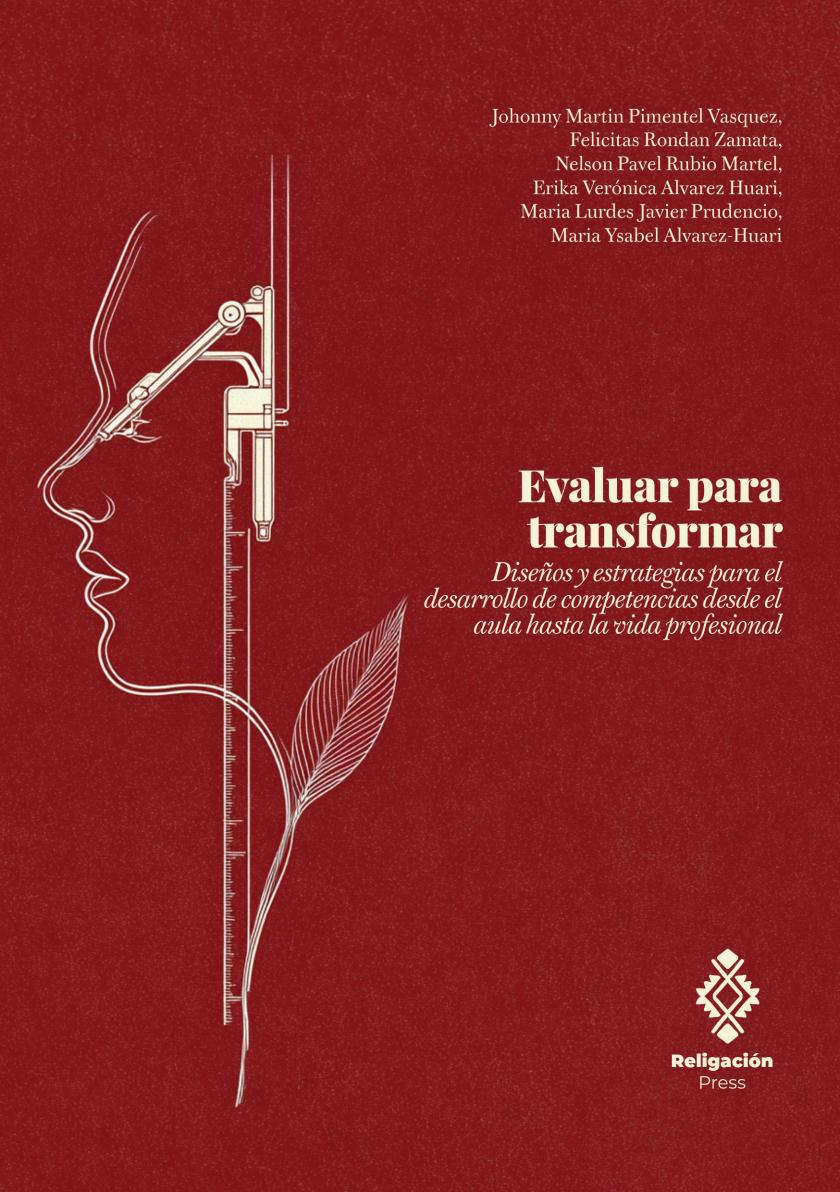
Assessing to Transform. Designs and Strategies for Competency Development from the Classroom to Professional Life
Keywords:
Evaluation; competencies; teaching and learning; taxonomy.Synopsis
The present book deals with educational assessment as a comprehensive process that integrates teaching and learning, aimed at developing competencies for life and work. It presents the foundations of constructivism and its main exponents, highlighting the importance of active learning, metacognition, and the transformative role of teachers and students. It describes approaches and practices of formative and authentic assessment, linked to Bloom’s taxonomy and its revision, which allow the design of progressive activities from remembering to creating. Likewise, it presents strategies such as self-assessment, peer assessment, observation, and the use of tools like rubrics, portfolios, and reflective journals. The text also analyzes the limits of classical constructivism and proposes its articulation with the competency-based approach, emphasizing the need for contextualized, relevant, and applicable learning to real-life situations. Altogether, the book offers an updated overview for understanding and applying assessment as a pedagogical, ethical, and transformative tool.
Downloads
Download data is not yet available.
References
Anderson, L. W., & Krathwohl, D. R. (Eds.). (2001). A taxonomy for learning, teaching, and assessing: A revision of Bloom’s taxonomy of educational objectives. Longman.
Andrade, H. (2005). Teaching with rubrics: The good, the bad, and the ugly. College Teaching, 53(1), 27–31. https://doi.org/10.3200/CTCH.53.1.27-31
Ausubel, D. P. (1963). The psychology of meaningful verbal learning. Grune & Stratton.
Ausubel, D. P. (1968). Educational psychology: A cognitive view. Holt, Rinehart and Winston.
Bell, S. (2010). Project-based learning for the 21st century: Skills for the future. The Clearing House: A Journal of Educational Strategies, Issues and Ideas, 83(2), 39–43. https://doi.org/10.1080/00098650903505415
Bendfeldt Reyes, E. H. (s. f.). Estudio de casos – metodologías didácticas en la educación superior. Weebly. https://h7.cl/1jUY8
Biggs, J., & Tang, C. (2011). Teaching for quality learning at university: What the student does. McGraw-Hill Education.
Black, P., & Wiliam, D. (1998). Inside the black box: Raising standards through classroom assessment. GL Assessment.
Bloom, B. S. (1956). Taxonomy of educational objectives: The classification of educational goals. Handbook I: Cognitive domain. David McKay.
Boote, D. N., & Beile, P. (2005). Scholars before researchers: On the centrality of the dissertation literature review in research preparation. Educational Researcher, 34(6), 3–15. https://doi.org/10.3102/0013189X034006003
Brookhart, S. M. (2013). How to create and use rubrics for formative assessment and grading. ASCD.
Brookhart, S. M. (2017). How to give effective feedback to your students. ASCD.
Bruner, J. S. (1960). The process of education. Harvard University Press.
Bruner, J. S. (1966). Toward a theory of instruction. Harvard University Press.
Caprara, D., Forte, A. M., & Cano, E. (2021). Evaluación y tecnología: Cómo usar medios digitales para enseñar mejor. Editorial Graó.
Christensen, C. R., Garvin, D. A., & Sweet, A. (1991). Educating for judgment: The artistry of discussion leadership. Harvard Business School Press.
Coll, C. (2005). Psicología de la educación y práctica educativa: Construir el conocimiento escolar. Editorial Paidós.
Delors, J., Al Mufti, I., Amagi, I., Carneiro, R., Chung, F., Geremek, B., & Nanzhao, Z. (1996). La educación encierra un tesoro: Informe a la UNESCO de la Comisión Internacional sobre la Educación para el siglo XXI. UNESCO.
Dewey, J. (1938). Experience and education. Kappa Delta Pi.
Díaz Barriga, F. (2013). Estrategias docentes para un aprendizaje significativo. McGraw-Hill.
Dirección General del Bachillerato. (2008). Modelo educativo y académico del Sistema Nacional de Bachillerato basado en competencias. Secretaría de Educación Pública.
Erskine, J. A., Leenders, M. R., & Mauffette-Leenders, L. A. (1997). Teaching with cases. Richard Ivey School of Business.
Escudero, J. M. (2006). Evaluar competencias en la educación superior: De los principios a las prácticas. Editorial Narcea.
European Commission. (2006). Recommendation of the European Parliament and of the Council of 18 December 2006 on key competences for lifelong learning. Office for Official Publications of the European Communities.
Flavell, J. H. (1979). Metacognition and cognitive monitoring: A new area of cognitive–developmental inquiry. American Psychologist, 34(10), 906–911. https://doi.org/10.1037/0003-066X.34.10.906
Freire, P. (1970). Pedagogy of the oppressed. Herder & Herder.
Freire, P. (1997). Pedagogía de la autonomía: Saberes necesarios para la práctica educativa. Paz e Terra.
García Aretio, L. (2014). La educación a distancia: De la teoría a la práctica. Editorial UNED.
Gibbert, M., & Ruigrok, W. (2008). The “what” and “how” of case study rigor: Three strategies based on published work. Organizational Research Methods, 11(4), 710–737. https://doi.org/10.1177/1094428107309890
Gibbert, M., Ruigrok, W., & Wicki, B. (2008). What passes as a rigorous case study? Strategic Management Journal, 29(13), 1465–1474. https://doi.org/10.1002/smj.722
Glaser, B. G. (1978). Theoretical sensitivity: Advances in the methodology of grounded theory. Sociology Press.
Hattie, J., & Timperley, H. (2007). The power of feedback. Review of Educational Research, 77(1), 81–112. https://doi.org/10.3102/003465430298487
Helle, L., Tynjälä, P., & Olkinuora, E. (2006). Project-based learning in post-secondary education – theory, practice and rubber sling shots. Higher Education, 51(2), 287–314. https://doi.org/10.1007/s10734-004-6386-5
Iturrioz, I. (2019). Aprendizaje experiencial: Teoría, metodología y práctica pedagógica crítica en la universidad. Editorial UOC.
Kimball, B. A. (2006). The proliferation of case method teaching in American law schools: Mr. Langdell’s emblematic abridgement, 1906–2000. Law and History Review, 24(3), 629–681. https://doi.org/10.1017/S073824800000394X
Kolb, A. Y., & Kolb, D. A. (2009). Experiential learning theory: A dynamic, holistic approach to management learning, education and development. En S. J. Armstrong, & C. V. Fukami, (eds.). The SAGE handbook of management learning, education and development (pp. 42–68). SAGE Publications.
Kolb, D. A. (1984). Experiential learning: Experience as the source of learning and development. Prentice Hall.
Kolb, D. A. (2015). Experiential learning: Experience as the source of learning and development. Pearson Education.
Lane, J. L. (2007). Case writing guide. Schreyer Institute for Teaching Excellence, The Pennsylvania State University.
Larmer, J., Mergendoller, J. R., & Boss, S. (2015). Setting the standard for project based learning: A proven approach to rigorous classroom instruction. ASCD.
Marín Díaz, V. (2014). La educación basada en competencias: Un enfoque de formación integral. Editorial Académica Española.
Marzano, R. J., & Kendall, J. S. (2007). The new taxonomy of educational objectives. Corwin Press.
Maxwell, J. A. (2012). Qualitative research design: An interactive approach. SAGE Publications.
Mendoza Rojas, G. (2012). Educación basada en competencias: Una alternativa al modelo academicista. Editorial Trillas.
Mergendoller, J. R., Maxwell, N. L., & Bellisimo, Y. (2006). The effectiveness of problem-based instruction: A comparative study of instructional methods and student characteristics. Interdisciplinary Journal of Problem-Based Learning, 1(2), 49–69. https://doi.org/10.7771/1541-5015.1026
Ministerio de Educación de Chile. (2004). Reforma educativa chilena: Balance y desafíos. Centro de Estudios MINEDUC.
Ministerio de Educación del Perú. (2016). Currículo nacional de la educación básica.
Ministerio de Educación del Perú. (2020). Diseño curricular básico para la educación superior tecnológica.
Ministerio de Educación Nacional de Colombia. (2006). Estándares básicos de competencias en lenguaje, matemáticas, ciencias y ciudadanía: Guía para el trabajo en el aula. Imprenta Nacional de Colombia.
Montiel Galindo, M. A., Charles Estrada, D. G., & Olivares, S. L. (2018). Método de casos como estrategia didáctica para desarrollar el pensamiento crítico en estudiantes de turismo. Ciencia, Docencia y Tecnología, 29(57), 88–110. https://doi.org/10.33255/2957/378
Mueller, J. (2005). Authentic assessment toolbox: Enhancing student learning through online faculty development. Center for Teaching and Learning, North Central College.
Nanyang Technological University. (2025). Structure of a report (Case study, Literature review or Survey). CC0006 Basics of Report Writing. NTU Library.
Novak, J. D., & Gowin, D. B. (1988). Aprendiendo a aprender. Martínez Roca.
OCDE. (2005). La definición y selección de competencias clave: Resumen ejecutivo del proyecto DeSeCo.
OCDE. (2018). El futuro de la educación y las habilidades: Educación 2030. Marco de aprendizaje para el siglo XXI.
Peralvo Arequipa, C. del R., & Chancusi Herrera, A. A. (2021). El método de casos en las estrategias metodológicas de enseñanza y aprendizaje. Revista Científica Hallazgos, 6(3), 369–389. https://doi.org/10.69890/hallazgos21.v6i3.544
Perrenoud, P. (2004). Diez nuevas competencias para enseñar. Graó.
Piaget, J. (1972). The principles of genetic epistemology. Basic Books.
Piaget, J. (1975). Biological adaptation and the psychology of intelligence. Klett-Cotta.
Popham, W. J. (2006). Mastering assessment: A self-service system for educators. Routledge.
Pozo, J. I. (1996a). Aprendices y maestros: La nueva cultura del aprendizaje. Editorial Alianza.
Pozo, J. I. (1996b). Teorías cognitivas del aprendizaje. Editorial Morata.
Sato, T. (2016). Case study epistemology: Holistic and experiential insights into qualitative research. Integrative Psychological and Behavioral Science, 50(2), 293–307. https://doi.org/10.1007/s12124-015-9322-0
Simpson, E. J. (1972). The classification of educational objectives in the psychomotor domain. Gryphon House.
Stake, R. E. (1995). The art of case study research. SAGE Publications.
Stoller, F. L. (2006). Establishing a theoretical foundation for project-based learning in second and foreign language contexts. En G. H. Beckett, & P. C. Miller, (eds.). Project-based second and foreign language education: Past, present, and future (pp. 19–40). Information Age Publishing.
Strauss, A. L., & Corbin, J. M. (1990). Basics of qualitative research: Grounded theory procedures and techniques. SAGE Publications.
Thomas, J. W. (2000). A review of research on project-based learning. Autodesk Foundation.
Tobías, E., & Moya, S. (2020). Evaluar para aprender: La evaluación formativa en el aula. Narcea Ediciones.
Tobón, S. (2013a). Evaluación de competencias: Fundamentos, estrategias e instrumentos. Ecoe Ediciones.
Tobón, S. (2013b). Formación integral y competencias: Pensamiento complejo, currículo, didáctica y evaluación. Ecoe Ediciones.
Tobón, S. (2013c). La evaluación de competencias en la educación básica: Retos y propuestas. Ecoe Ediciones.
UNESCO. (1998). Educación: Un tesoro por descubrir. Informe para la UNESCO de la Comisión Internacional sobre la Educación para el siglo XXI.
UNESCO. (2015). Rethinking education: Towards a global common good?
UNESCO. (2019). Marco de competencias de los docentes en materia de TIC.
Vygotsky, L. S. (1978). Mind in society: The development of higher psychological processes. Harvard University Press.
Wasti, S. P., Simkhada, P., van Teijlingen, E., Sathian, B., & Banerjee, I. (2022). The growing importance of mixed-methods research in health. Nepal Journal of Epidemiology, 12(1), 1175–1178. https://doi.org/10.3126/nje.v12i1.43633
Wiggins, G., & McTighe, J. (2005). Understanding by design. ASCD.
Yin, R. K. (1989). Case study research: Design and methods (1.ª ed.). SAGE Publications.
Yin, R. K. (1993). Case study research: Design and methods (2.ª ed.). SAGE Publications.
Yin, R. K. (2009). Case study research: Design and methods (4.ª ed.). SAGE Publications.
Zabala, A., & Arnau, L. (2007). 10 ideas clave: Cómo aprender y enseñar competencias. Editorial Graó.
Zabalza, M. A. (2011). Competencias docentes del profesorado universitario: Calidad y desarrollo profesional. Narcea Ediciones.
Published
December 19, 2025
Series
Copyright (c) 2025 Johonny Martin Pimentel Vásquez, Felicitas Rondan Zamata, Nelson Pavel Rubio Martel, Erika Verónica Alvarez Huari, Maria Lurdes Javier Prudencio, Maria Ysabel Alvarez-Huari

Details about the available publication format: PDF
PDF
ISBN-13 (15)
978-9942-594-11-2
Publication date (01)
2025-12-19