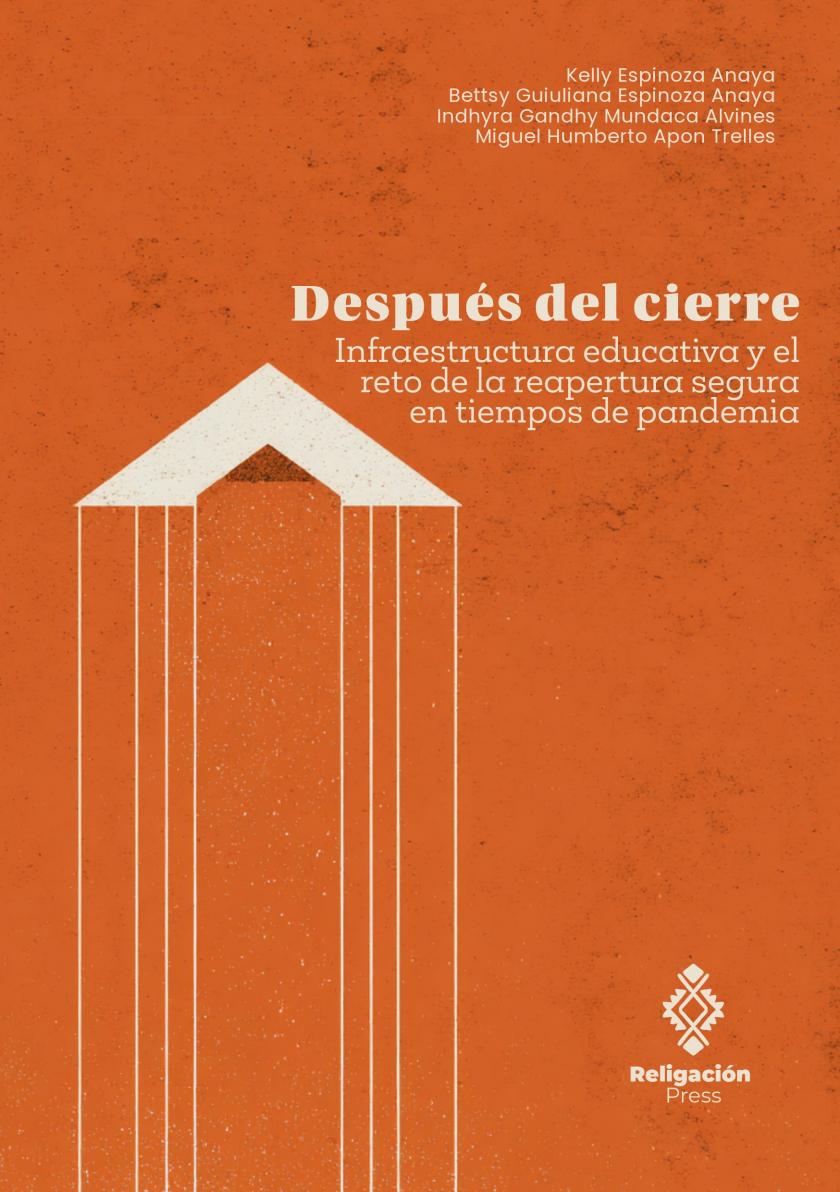
After the Shutdown. Educational Infrastructure and the Challenge of Safe Reopening During the Pandemic
Keywords:
Educational infrastructure, COVID-19 pandemic, school reopening, educational equity, Cañaris Lambayeque.Synopsis
This work addresses the global and local educational crisis triggered by the COVID-19 pandemic, focusing on the challenge of a safe and equitable school reopening. The book exposes how the massive closure of schools revealed and deepened the pre-existing severe gaps in educational infrastructure, particularly in regions of Latin America and in Peru. It argues that guaranteeing basic conditions such as ventilation, access to water, and adequate spaces became an imperative sanitary and educational requirement. Centering its analysis on the district of Cañaris in Lambayeque, a rural area with high levels of poverty, the research aims to determine the critical impact of school infrastructure across dimensions such as safety, flexibility, graduality, and voluntariness on the provision of educational services during the new normal. This study not only seeks to diagnose an urgent problem but also to contribute fundamental knowledge to guide educational investment and reconstruction policies, prioritizing student safety and service quality in the post-pandemic landscape.
Downloads
Download data is not yet available.
References
Alvarez, C. A. (2020). Infraestructura y calidad educativa en las Instituciones JEC [Tesis de maestría, Universidad San Ignacio de Loyola].
Askar, G., Al-Ansi, A. M., & Qamari, I. N. (2021). The role of e-learning infrastructure and cognitive competence in distance learning effectiveness during the COVID-19 pandemic. Cakrawala Pendidikan, 40(1), 81–91. https://doi.org/10.21831/cp.v40i1.33474
Azcona, M. (2013). El contexto onto-epistemológico de las investigaciones científicas. Editorial de la Universidad Nacional de La Plata.
Baena, G. (2017). Metodología de la investigación. Grupo Editorial Patria.
Barrett, P., Treves, A., Shmis, T., Ambasz, D., & Ustinova, M. (2019). The impact of school infrastructure on learning: A synthesis of the evidence. International Development in Focus. World Bank.
Berke, E. M., Newman, L. M., Jemsby, S., Hyde, B., Bhalla, N., Sheils, N. E., Oomman, N., Reppas, J., Verma, P., & Cangelosi, G. A. (2021). Pooling in a pod: A strategy for COVID-19 testing to facilitate a safe return to school. Public Health Reports, 136(6), 663–668. https://doi.org/10.1177/00333549211045816
Brittin, J., Frerichs, L., Sirard, J. R., Wells, N. M., Myers, B. M., Garcia, J., & Huang, T. (2017). Impacts of active school design on school-time sedentary behavior and physical activity: A pilot natural experiment. PLoS ONE, 12(12). https://doi.org/10.1371/journal.pone.0189236
Cala, J., González, M., Ponz, J., Gutiérrez, J., & Arboleda, C. (2017). Quantitative analysis of the educational infrastructure in Colombia through the use of a georeferencing software and analytic hierarchy process. Espacios, 38(56).
Comisión Económica para América Latina y el Caribe (CEPAL) & Organización de las Naciones Unidas para la Educación, la Ciencia y la Cultura (UNESCO). (2020). La educación en tiempos de la pandemia de COVID-19 (Informe COVID-19).
Consejo Nacional de Educación del Perú. (2020). El Proyecto Educativo Nacional al 2036: El reto de la ciudadanía plena.
Chávez Cortes, O. M. (2020). Criterios normativos y la infraestructura educativa de las instituciones públicas del distrito de Santiago de Surco – 2017 [Tesis de licenciatura, Universidad César Vallejo].
Domenico, L. D., Pullano, G., Sabbatini, C. E., Boëlle, P.-Y., & Colizza, V. (2021). Modelling safe protocols for reopening schools during the COVID-19 pandemic in France. Nature Communications, 12. https://doi.org/10.1038/s41467-021-21249-6
Escobar, A. A. H., Rodríguez, M. P. R., López, B. M. P., Ganchozo, B. I., Gómez, A. J. Q., & Ponce, L. A. M. (2018). Metodología de la investigación científica. Editorial y distribuidora Gráfica Oriente.
Espinoza Anaya, K. (2022). Infraestructura en el servicio educativo de las instituciones educativas públicas de educación básica regular de Cañaris, Lambayeque-2021 [Tesis de maestría, Universidad César Vallejo].
Flores, E. (2020). Infraestructura escolar e imagen institucional de las instituciones educativas Ugel 10 Chancay–2015 [Tesis de maestría, Universidad San Ignacio de Loyola].
Gillis, A., & Krull, L. M. (2020). COVID-19 remote learning transition in spring 2020: Class structures, student perceptions, and inequality in college courses. Teaching Sociology, 48(4), 283–299. https://doi.org/10.1177/0092055X20954263
Gómez-Escalonilla, G. (2021). Métodos y técnicas de investigación utilizados en los estudios sobre comunicación en España. Revista Mediterránea de Comunicación, 12(1), 17–31. https://doi.org/10.14198/MEDCOM000018
Hernández S., R., Fernández C., C., & Baptista L., P. (2014). Metodología de la investigación. McGraw-Hill Interamericana.
Honein, M. A., Barrios, L. C., & Brooks, J. T. (2021). Data and policy to guide opening schools safely to limit the spread of SARS-CoV-2 infection. JAMA, 325(9), 823–828. https://doi.org/10.1001/jama.2021.0374
Howard, P., O’Brien, C., Kay, B., & O’Rourke, K. (2019). Leading educational change in the 21st century: Creating living schools through shared vision and transformative governance. Sustainability, 11(15). https://doi.org/10.3390/su11154109
IBM. (2021). IBM SPSS Statistics 25.0.0: PLUM. https://n9.cl/uxxv2
Infrastructure Commission of New Zealand. (2021). Sector state of play: Education discussion document.
Instituto Nacional de Estadística e Informática (INEI) del Perú. (2020). Tecnologías de información y comunicación en los hogares [Estadística]. https://n9.cl/g0c6st
Instituto Universitario de Investigación en Estudios Norteamericanos (IISUE). (2020). Educación y pandemia. Una visión académica. Universidad Nacional Autónoma de México.
Inversión en la Infancia. (2020, 06 de octubre). Expertos analizan la educación en el país. https://inversionenlainfancia.net/blog/entrada/noticia/2209/0
Kamau, S. J., Rambo, C. M., & Mbugua, J. M. (2021). Influences of community participation on school infrastructure policy implementation and performance of construction projects. Open Journal of Social Sciences, 9, 173–187. https://doi.org/10.4236/jss.2021.93012
Landeros, A., Ji, X., Lange, K., Stutz, T. C., Xu, J., Sehl, M. E., ... & Enanoria, W. T. A. (2021). An examination of school reopening strategies during the SARS-CoV-2 pandemic. PLoS ONE, 16(5). https://doi.org/10.1371/journal.pone.0251242
Lorenc Valcarce, F. (2014). Émile Durkheim y la teoría sociológica de la acción. Andamios, 11(26), 299–322. https://doi.org/10.29092/uacm.v11i26.314
Lopez, J. M. (2021). Cautious and gradual reopening of limited face-to-face classes in Philippine tertiary schools. Journal of Public Health, 43(3), 538–539. https://doi.org/10.1093/pubmed/fdab060
Machaca Colque, N. U. (2021). Inversión en infraestructura educativa y rendimiento académico en el Perú. Un análisis comparativo regional, periodo 2007 -2018 [Tesis de maestría, Universidad Nacional del Altiplano].
Masduki, A. (2021). Management of facilities and infrastructure in schools. Jurnal Teknologi Pendidikan, 10(1), 60–71. https://doi.org/10.34005/akademika.v10i01.1348
Ministerio de Educación del Perú. (2017). ¿Cómo se relaciona la infraestructura de la escuela con los aprendizajes de los estudiantes? (Zoom educativo N° 3). Oficina de Medición de la Calidad de los Aprendizajes.
Ministerio de Educación del Perú. (2021). Resolución Ministerial N° 121-2021-MINEDU [Disposiciones para la prestación del servicio educativo durante la COVID-19]. Diario Oficial El Peruano.
Ministerio de Educación del Perú. (2021). Resolución Ministerial N° 190-2021-MINEDU [Norma Técnica: Criterios Generales de Diseño para infraestructura Educativa]. Diario Oficial El Peruano.
Ministerio de Educación y Ciencias del Paraguay. (2020). Protocolo y guía operativa para el retorno seguro a instituciones educativas.
Mutch, C. (2018). The role of schools in helping communities copes with earthquake disasters: The case of the 2010–2011 New Zealand earthquakes. Environmental Hazards, 17(3), 247–263. https://doi.org/10.1080/17477891.2018.1485547
Noblega, M. (2018). Evidencias de validez de constructo y de criterio de la Escala Massie-Campbell de Apego Durante Estrés (ADS). Avances en Psicología, 26(1), 87–101. https://doi.org/10.33539/avpsicol.2018.v26n1.1330
Observatorio de Argentinos por la Educación. (2021). Modalidad de vuelta a clases en la escuela primaria (Primer informe).
Organisation for Economic Co-operation and Development (OECD) NetFwd. (2020). Philanthropy and education: Education giving in the midst of COVID-19.
Organización de las Naciones Unidas (ONU). (2020). La educación durante la COVID-19 y después de ella (Informe de políticas).
Otzen, T., & Manterola, C. (2017). Técnicas de muestreo sobre una población a estudio. International Journal of Morphology, 35(1), 227–232. https://doi.org/10.4067/S0717-95022017000100037
Pokhrel, S., & Chhetri, R. (2021). A literature review on impact of COVID-19 pandemic on teaching and learning. Higher Education for the Future, 8(1), 133–141. https://doi.org/10.1177/2347631120983481
Programa Nacional de Infraestructura Educativa (PRONIED) del Perú. (2021). Programa de mantenimiento de locales educativos 2021. https://n9.cl/uctwcu
Quesada-Chaves, M. J. (2018). Condiciones de la infraestructura educativa en la región Pacífico Central: Los espacios escolares que promueven el aprendizaje en las aulas. Revista Educación, 43(1), 180–197. https://doi.org/10.15517/revedu.v43i1.28179
Ramos, C. (2015). Los paradigmas de la investigación científica. Avances en Psicología, 23(1), 9–17. https://doi.org/10.33539/avpsicol.2015.v23n1.167
Resch, K., & Schrittesser, I. (2021). Using the Service-Learning approach to bridge the gap between theory and practice in teacher education. International Journal of Inclusive Education, 27(10). https://doi.org/10.1080/13603116.2021.1882053
Rot, A., Chrobak, P., & Sobinska, M. (2019). Optimisation of the use of IT infrastructure resources in an institution of higher education: A case study. 2019 9th International Conference on Advanced Computer Information Technologies (ACIT). https://doi.org/10.1109/ACITT.2019.8780018
Ropa, B. (2014). Administración de la calidad en los servicios educativos. Horizonte de la Ciencia, 4(6), 91–96. https://doi.org/10.26490/uncp.horizonteciencia.2014.6.101
Samaneh, M., Farajzadeh, H., Mohammadinia, L., Norouzi, K., Dehghani-Tafti, A. A., R., Z., & Arsalani, H. R. (2021). Assessment of school resilience in disasters: A cross-sectional study. Journal of Education and Health Promotion, 10. https://doi.org/10.4103/jehp.jehp_633_20
Sánchez Carlessi, H., Reyes Romero, C., & Mejía Sáenz, K. (2018). Manual de términos en investigación científica, tecnológica y humanística. Universidad Ricardo Palma.
Semanario Comex Perú N° 1045. (2020). Sociedad de Comercio Exterior del Perú (COMEXPERÚ). https://n9.cl/7es8
Shmis, T., Ustinova, M., & Chugunov, D. (2020). Learning environments and learning achievement in the Russian Federation: How school infrastructure and climate affect student success. International Development in Focus. World Bank.
Soares, L., & Schoen, T. H. (2020). COVID-19 preventive measures for the return to school: Documents from 13 countries.
Subedi, S., Hetényi, G., & Shackleton, R. (2020). Impact of an educational program on earthquake awareness and preparedness in Nepal. Geoscience Communication, 3(2), 279–290. https://doi.org/10.5194/gc-3-279-2020
Trigoso Estrella, J. R. (2020). Gestión Educativa y Calidad de Servicio en la Institución Educativa “Angel Custodio García Ramirez” [Tesis de maestría, Universidad San Ignacio de Loyola].
Unidad de Reconstrucción con Cambios (ARCC) del Perú. (2021, 28 de mayo). Lambayeque: Reconstruyen cuatro colegios en la zona altoandina de Cañaris. https://n9.cl/4gaxvi
United Nations Educational, Scientific and Cultural Organization (UNESCO). (1985). Normas y estándares para las construcciones escolares.
Vara Horna, A. A. (2012). Desde la idea hasta la sustentación: 7 pasos para una tesis exitosa. Un método efectivo para las ciencias empresariales. Universidad de San Martín de Porres.
Vasco de Estadística (EUSTAT). (2021, 5 de diciembre). Servicios educativos y formativos: Definición. https://n9.cl/j56ub
Published
December 22, 2025
Series
Copyright (c) 2025 Kelly Espinoza Anaya, Bettsy Guiuliana Espinoza Anaya, Indhyra Gandhy Mundaca Alvines, Miguel Humberto Apon Trelles

Details about the available publication format: PDF
PDF
ISBN-13 (15)
978-9942-594-17-4
Publication date (01)
2025-12-22