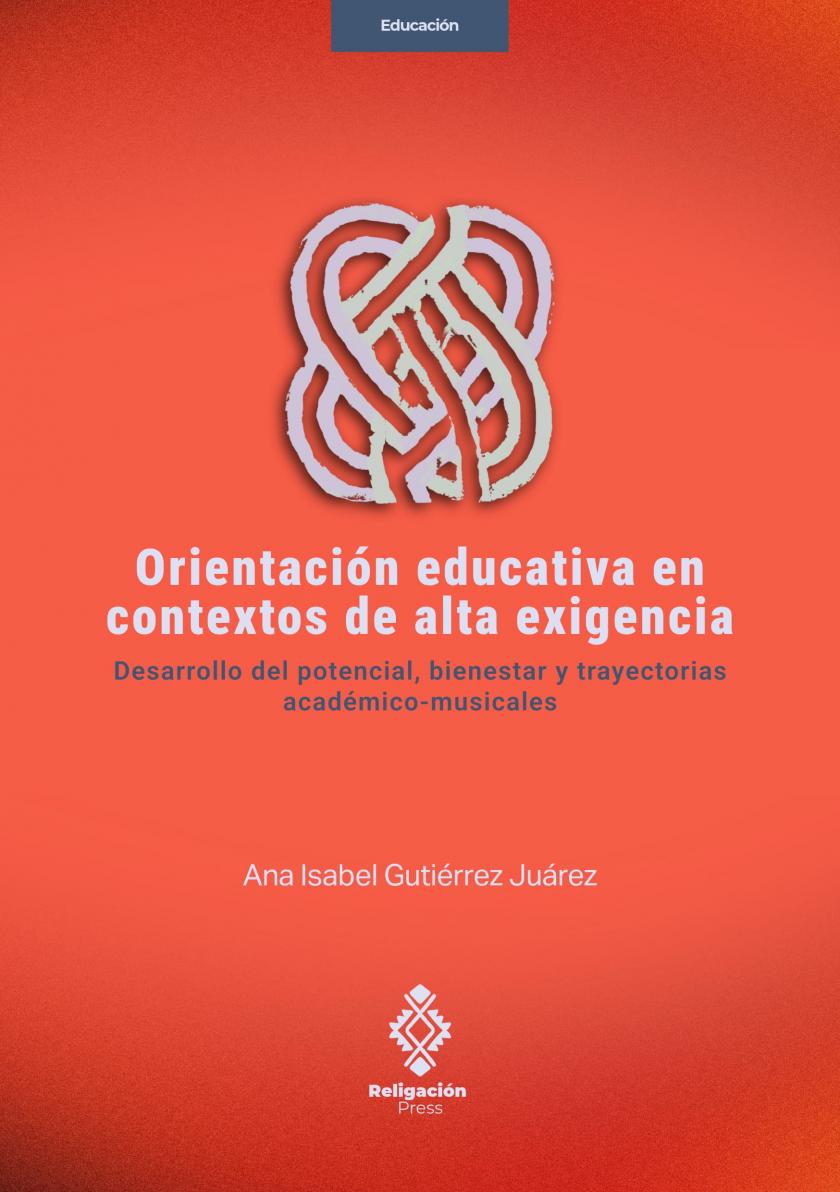
Educational guidance in high-demand contexts: development of potential, well-being, and academic-musical trajectories
Keywords:
Educational guidance; Music education; Well-being; Vocational guidance; Educational choice.Synopsis
This book examines educational guidance in high-demand educational contexts, focusing on specialized music education as a setting in which academic and artistic education, the development of potential, well-being, and future-oriented decision-making converge. It explores how preventive, personalized, comprehensive, and longitudinal guidance can be articulated to support students throughout these educational trajectories. The book combines a review of the scientific literature, regulatory and institutional analysis, and applied research conducted in an integrated music education school. Its four chapters address the foundations of guidance in high-demand educational contexts; the distinctive characteristics of specialized music education and its institutional guidance arrangements; emotional well-being from an educational and preventive perspective; and the integration of knowledge of the student, personalization, well-being, educational and career guidance, coordination, and follow-up in the progressive construction of students’ academic, artistic, and professional pathways.
Downloads
Download data is not yet available.
References
American Educational Research Association, American Psychological Association, & National Council on Measurement in Education. (2014). Standards for educational and psychological testing. American Educational Research Association.
Álvarez González, M., & Bisquerra Alzina, R. (2017). Orientación educativa: Modelos, áreas, estrategias y recursos. Wolters Kluwer Educación.
Bartleet, B.-L., Ballico, C., Bennett, D., Bridgstock, R., Draper, P., Tomlinson, V., & Harrison, S. (2019). Building sustainable portfolio careers in music: Insights and implications for higher education. Music Education Research, 21(3), 282–294. https://doi.org/10.1080/14613808.2019.1598348
Bernacki, M. L., Greene, M. J., & Lobczowski, N. G. (2021). A systematic review of research on personalized learning: Personalized by whom, to what, how, and for what purpose(s)? Educational Psychology Review, 33(4), 1675–1715. https://doi.org/10.1007/s10648-021-09615-8
Boletín Oficial del Estado. (1990). Ley Orgánica 1/1990, de 3 de octubre, de Ordenación General del Sistema Educativo. https://n9.cl/482s7
Boletín Oficial del Estado. (2006). Ley Orgánica 2/2006, de 3 de mayo, de Educación. https://www.boe.es/buscar/act.php?id=BOE-A-2006-7899
Boletín Oficial del Estado. (2007). Real Decreto 1577/2006, de 22 de diciembre, por el que se fijan los aspectos básicos del currículo de las enseñanzas profesionales de música reguladas por la Ley Orgánica 2/2006, de 3 de mayo, de Educación. https://www.boe.es/eli/es/rd/2006/12/22/1577/con
Boletín Oficial del Estado. (2009). Real Decreto 1614/2009, de 26 de octubre, por el que se establece la ordenación de las enseñanzas artísticas superiores reguladas por la Ley Orgánica 2/2006, de 3 de mayo, de Educación. https://www.boe.es/eli/es/rd/2009/10/26/1614/con
Boletín Oficial del Estado. (2020). Ley Orgánica 3/2020, de 29 de diciembre, por la que se modifica la Ley Orgánica 2/2006, de 3 de mayo, de Educación. https://www.boe.es/eli/es/lo/2020/12/29/3
Boletín Oficial del Estado. (2022). Decreto 8/2022, de 16 de marzo, del Consejo de Gobierno, por el que se aprueba el reglamento orgánico de los conservatorios profesionales y de los centros integrados de enseñanzas artísticas de música de la Comunidad de Madrid. https://n9.cl/3aeqq
Boletín Oficial del Estado. (2023). Decreto 23/2023, de 22 de marzo, del Consejo de Gobierno, por el que se regula la atención educativa a las diferencias individuales del alumnado en la Comunidad de Madrid. https://n9.cl/227th
Boletín Oficial del Estado. (2023). Decreto 243/2023, de 4 de octubre, del Consejo de Gobierno, por el que se crea el Centro Regional de Enriquecimiento Educativo para el alumnado con Altas Capacidades Intelectuales de la Comunidad de Madrid y se establece su régimen jurídico y estructura. https://www.bocm.es/eli/es-md/d/2023/10/04/243/con
Boletín Oficial del Estado. (2024). Ley 1/2024, de 7 de junio, por la que se regulan las enseñanzas artísticas superiores y se establece la organización y equivalencias de las enseñanzas artísticas profesionales. https://n9.cl/5mt7c9
Boletín Oficial de la Comunidad de Madrid. (2006). Orden 4917/2006, de 4 de septiembre, del Consejero de Educación, por la que se regulan las enseñanzas y la organización y el funcionamiento de los Centros Integrados de Enseñanzas Artísticas de Música y de Educación Primaria, Educación Secundaria Obligatoria y Bachillerato en la Comunidad de Madrid.
Boletín Oficial de la Comunidad de Madrid. (2008). Orden 3893/2008, de 31 de julio, de la Consejería de Educación, por la que se regulan las enseñanzas y la organización y el funcionamiento de los Centros Integrados de Enseñanzas Artísticas de Música y de Educación Primaria, Educación Secundaria Obligatoria y Bachillerato en la Comunidad de Madrid. https://n9.cl/io56cl
Boletín Oficial de la Comunidad de Madrid. (2016). Orden 2579/2016, de 17 de agosto, de la Consejería de Educación, Juventud y Deporte, por la que se regulan las enseñanzas y la organización y el funcionamiento de los Centros Integrados de Enseñanzas Artísticas de Música y de Educación Primaria, Educación Secundaria Obligatoria y Bachillerato en la Comunidad de Madrid.
Boletín Oficial de la Comunidad de Madrid. (2020). Orden 2642/2020, de 16 de octubre, de la Consejería de Educación y Juventud, por la que se crea el Equipo de Orientación Educativa y Psicopedagógica Específico de Altas Capacidades. https://n9.cl/9e4w0c
Boletín Oficial de la Comunidad de Madrid. (2025). Orden 4192/2025, de 18 de septiembre, de la Consejería de Educación, Ciencia y Universidades, por la que se regulan determinados aspectos de la ordenación, organización, evaluación y funcionamiento de los centros integrados de enseñanzas artísticas de música y de Educación Primaria, Educación Secundaria Obligatoria y Bachillerato en la Comunidad de Madrid. https://n9.cl/cet5d
Bonneville-Roussy, A., Hruska, E., & Trower, H. (2020). Teaching music to support students: How autonomy-supportive music teachers increase students’ well-being. Journal of Research in Music Education, 68(1), 97–119. https://doi.org/10.1177/0022429419897611
Bragle, J. A., & Dansereau, D. R. (2024). Groups and biases: The role of social identity in the musical career path aspirations of adolescent musicians. Journal of Research in Music Education, 72(3), 314–330. https://doi.org/10.1177/00224294231211911
Braun, V., & Clarke, V. (2006). Using thematic analysis in psychology. Qualitative Research in Psychology, 3(2), 77–101. https://doi.org/10.1191/1478088706qp063oa
Cipriano, C., Strambler, M. J., Naples, L. H., Ha, C., Kirk, M., Wood, M., Sehgal, K., Zieher, A. K., Eveleigh, A., McCarthy, M., Funaro, M., Ponnock, A., Chow, J. C., & Durlak, J. A. (2023). The state of evidence for social and emotional learning: A contemporary meta-analysis of universal school-based SEL interventions. Child Development, 94(5), 1181–1204. https://doi.org/10.1111/cdev.13968
Comunidad de Madrid. (2014, 15 de diciembre). Conservatorios Profesionales de Música y Danza. Portal de Transparencia. https://n9.cl/8jyhr6
Comunidad de Madrid. (2025, 3 de septiembre). La Comunidad de Madrid inicia el curso escolar con bajada de ratios en las aulas y récord de estudiantes y docentes en los centros públicos. https://n9.cl/ex36l
Creech, A. (2010). Learning a musical instrument: The case for parental support. Music Education Research, 12(1), 13–32. https://doi.org/10.1080/14613800903569237
De Vos, A., Van der Heijden, B. I. J. M., & Akkermans, J. (2020). Sustainable careers: Towards a conceptual model. Journal of Vocational Behavior, 117. https://doi.org/10.1016/j.jvb.2018.06.011
Durlak, J. A., Weissberg, R. P., Dymnicki, A. B., Taylor, R. D., & Schellinger, K. B. (2011). The impact of enhancing students’ social and emotional learning: A meta-analysis of school-based universal interventions. Child Development, 82(1), 405–432. https://doi.org/10.1111/j.1467-8624.2010.01564.x
Evans, P., & McPherson, G. E. (2015). Identity and practice: The motivational benefits of a long-term musical identity. Psychology of Music, 43(3), 407–422. https://doi.org/10.1177/0305735613514471
Evans, P., & McPherson, G. E. (2017). Processes of musical identity consolidation during adolescence. In R. A. R. MacDonald, D. J. Hargreaves, & D. Miell, (eds.). Handbook of musical identities (pp. 213–231). Oxford University Press. https://doi.org/10.1093/acprof:oso/9780199679485.003.0012
Evans, P., McPherson, G. E., & Davidson, J. W. (2013). The role of psychological needs in ceasing music and music learning activities. Psychology of Music, 41(5), 600–619. https://doi.org/10.1177/0305735612441736
Gembris, H., Menze, J., Heye, A., & Bullerjahn, C. (2020). High-performing young musicians’ playing-related pain: Results of a large-scale study. Frontiers in Psychology, 11. https://doi.org/10.3389/fpsyg.2020.564736
Goopy, J. (2023). Intersections and conflicts between adolescent boys’ musical possible selves, university study, and parent values. Psychology of Music, 51(2), 624–639. https://doi.org/10.1177/03057356221101651
Griffiths, A.-J., Alsip, J., Hart, S. R., Round, R. L., & Brady, J. (2021). Together we can do so much: A systematic review and conceptual framework of collaboration in schools. Canadian Journal of School Psychology, 36(1), 59–85. https://doi.org/10.1177/0829573520915368
Grugan, M. C., Hill, A. P., Madigan, D. J., Donachie, T. C., Olsson, L. F., & Etherson, M. E. (2021). Perfectionism in academically gifted students: A systematic review. Educational Psychology Review, 33(4), 1631–1673. https://doi.org/10.1007/s10648-021-09597-7
Gysbers, N. C. (2004). Comprehensive guidance and counseling programs: The evolution of accountability. Professional School Counseling, 8(1), 1–14.
Hernández Rivero, V., & Mederos Santana, Y. (2018). Papel del orientador/a educativo como asesor/a: Funciones y estrategias de apoyo. Revista Española de Orientación y Psicopedagogía, 29(1), 40–57. https://doi.org/10.5944/reop.vol.29.num.1.2018.23293
Johnson, K. F., Belcher, T. W., Zimmerman, B., & Franklin, J. (2020). Interprofessional partnerships involving school counsellors for children with special needs: A broad based systematic review using the PRISMA framework. Support for Learning, 35(1), 43–67. https://doi.org/10.1111/1467-9604.12285
Juuti, S., & Littleton, K. (2010). Musical identities in transition: Solo-piano students’ accounts of entering the academy. Psychology of Music, 38(4), 481–497. https://doi.org/10.1177/0305735609351915
Lent, R. W., Ezeofor, I., Morrison, M. A., Penn, L. T., & Ireland, G. W. (2016). Applying the social cognitive model of career self-management to career exploration and decision-making. Journal of Vocational Behavior, 93, 47–57. https://doi.org/10.1016/j.jvb.2015.12.007
López-Íñiguez, G., & Bennett, D. (2021). Broadening student musicians’ career horizons: The importance of being and becoming a learner in higher education. International Journal of Music Education, 39(2), 134–150. https://doi.org/10.1177/0255761421989111
López-Íñiguez, G., & McPherson, G. E. (2023). Caring approaches to young, gifted music learners’ education: A PRISMA scoping review. Frontiers in Psychology, 14. https://doi.org/10.3389/fpsyg.2023.1167292
Luthar, S. S., Suh, B. C., Ebbert, A. M., & Kumar, N. L. (2020). Students in high-achieving schools: Perils of pressures to be “standouts”. Adversity and Resilience Science, 1, 135–147. https://doi.org/10.1007/s42844-020-00009-3
Mazzarolo, I., Burwell, K., & Schubert, E. (2023). Teachers’ approaches to music performance anxiety management: A systematic review. Frontiers in Psychology, 14. https://doi.org/10.3389/fpsyg.2023.1205150
McPherson, G. E., & Renwick, J. M. (2001). A longitudinal study of self-regulation in children’s musical practice. Music Education Research, 3(2), 169–186. https://doi.org/10.1080/14613800120089232
Miao, F., & Holmes, W. (2023). Guidance for generative AI in education and research. UNESCO. https://doi.org/10.54675/EWZM9535
Moliner García, O., & Fabregat Mas, P. (2021). Nuevos roles y estrategias de asesoramiento psicopedagógico para promover la educación inclusiva en la Comunidad Valenciana. Revista Española de Orientación y Psicopedagogía, 32(1), 59–75. https://doi.org/10.5944/reop.vol.32.num.1.2021.30740
Mudarra Sánchez, M. J., González-Benito, A., & Vélaz-de-Medrano Ureta, C. (2020). Debilidades del sistema de orientación español según los tutores y directores de educación secundaria. Bordón. Revista de Pedagogía, 72(1), 67–84. https://doi.org/10.13042/Bordon.2020.01.73215
Nitz, J., Brack, F., Hertel, S., Krull, J., Stephan, H., Hennemann, T., & Hanisch, C. (2023). Multi-tiered systems of support with focus on behavioral modification in elementary schools: A systematic review. Heliyon, 9(6). https://doi.org/10.1016/j.heliyon.2023.e17506
Oberlin College and Conservatory. (s. f.). Double Degree Program at Oberlin. https://www.oberlin.edu/double-degree-program-oberlin
OECD. (2023). OECD Digital Education Outlook 2023: Towards an effective digital education ecosystem. OECD Publishing. https://doi.org/10.1787/c74f03de-en
OECD. (2023). Career talks with guest speakers: A guide to delivering an effective career development activity (OECD Education Policy Perspectives No. 69). OECD Publishing. https://doi.org/10.1787/93594cb3-en
OECD. (2024). Teenage career uncertainty: Why it matters and how to reduce it? (OECD Education Spotlights No. 16). OECD Publishing. https://doi.org/10.1787/e89c3da9-en
OECD. (2025). The state of global teenage career preparation. OECD Publishing. https://doi.org/10.1787/d5f8e3f2-en
Ogurlu, U. (2020). Are gifted students perfectionistic? A meta-analysis. Journal for the Education of the Gifted, 43(3), 227–251. https://doi.org/10.1177/0162353220933006
Orejudo, S., Zarza-Alzugaray, F. J., Casanova, O., & McPherson, G. E. (2021). Social support as a facilitator of musical self-efficacy. Frontiers in Psychology, 12. https://doi.org/10.3389/fpsyg.2021.722082
Osborne, M. S., & Kenny, D. T. (2005). Development and validation of a music performance anxiety inventory for gifted adolescent musicians. Journal of Anxiety Disorders, 19(7), 725–751. https://doi.org/10.1016/j.janxdis.2004.09.002
Papageorgi, I. (2021). Typologies of adolescent musicians and experiences of performance anxiety among instrumental learners. Frontiers in Psychology, 12. https://doi.org/10.3389/fpsyg.2021.645993
Papageorgi, I. (2022). Prevalence and predictors of music performance anxiety in adolescent learners: Contributions of individual, task-related and environmental factors. Musicae Scientiae, 26(1), 101–122. https://doi.org/10.1177/1029864920923128
Parker, E. C. (2020). Adolescents on music: Why music matters in schools. Oxford University Press.
Ravens-Sieberer, U., Auquier, P., Erhart, M., Gosch, A., Rajmil, L., Bruil, J., Power, M., Duer, W., Cloetta, B., Czemy, L., Mazur, J., Czimbalmos, A., Tountas, Y., Hagquist, C., Kilroe, J., & European KIDSCREEN Group. (2007). The KIDSCREEN-27 quality of life measure for children and adolescents: Psychometric results from a cross-cultural survey in 13 European countries. Quality of Life Research, 16(8), 1347–1356. https://doi.org/10.1007/s11136-007-9240-2
Real Conservatorio Superior de Música de Madrid. (s. f.). Servicio de Orientación y de Apoyo Escénico Emocional. https://n9.cl/6q9rp
Reyes-Parra, P. A., Moreno Castiblanco, A. N., Amaya Ruiz, A., & Avendaño Angarita, M. Y. (2020). Educación inclusiva: Una revisión sistemática de investigaciones en estudiantes, docentes, familias e instituciones, y sus implicaciones para la orientación educativa. Revista Española de Orientación y Psicopedagogía, 31(3), 86–108. https://doi.org/10.5944/reop.vol.31.num.3.2020.29263
Reynen, K., Round, P., & Subban, P. (2023). Gifted, disadvantaged, unseen: A scoping study of giftedness, disadvantage and cultural difference in young adult learners. Social Sciences & Humanities Open, 7(1). https://doi.org/10.1016/j.ssaho.2023.100477
Rudolph, C. W., Lavigne, K. N., & Zacher, H. (2017). Career adaptability: A meta-analysis of relationships with measures of adaptivity, adapting responses, and adaptation results. Journal of Vocational Behavior, 98, 17–34. https://doi.org/10.1016/j.jvb.2016.09.002
Sala, G., & Gobet, F. (2020). Cognitive and academic benefits of music training with children: A multilevel meta-analysis. Memory & Cognition, 48(8), 1429–1441. https://doi.org/10.3758/s13421-020-01060-2
Sánchez-Escribano García de la Rosa, E., & Alcaraz-León, F. J. (2026). Abandono educativo en conservatorios de música: Análisis de causas y posibles soluciones desde la perspectiva del profesorado. RECIEM. Revista Electrónica Complutense en Educación Musical, 23(1), 1–14. https://doi.org/10.5209/reciem.92328
Savickas, M. L., Nota, L., Rossier, J., Dauwalder, J.-P., Duarte, M. E., Guichard, J., Soresi, S., Van Esbroeck, R., & van Vianen, A. E. M. (2009). Life designing: A paradigm for career construction in the 21st century. Journal of Vocational Behavior, 75(3), 239–250. https://doi.org/10.1016/j.jvb.2009.04.004
Shadish, W. R., Cook, T. D., & Campbell, D. T. (2002). Experimental and quasi-experimental designs for generalized causal inference. Houghton Mifflin.
Slaten, C. D., Lee, J., Wachter-Morris, C., Williams, M. S., & Huynh, J. (2024). School counselors in the classroom: A systematic review. Journal of Counseling & Development, 102(4), 415–430. https://doi.org/10.1002/jcad.12522
Spahn, C., Tenbaum, P., Immerz, A., Hohagen, J., & Nusseck, M. (2023). Dispositional and performance-specific music performance anxiety in young amateur musicians. Frontiers in Psychology, 14. https://doi.org/10.3389/fpsyg.2023.1208311
Stake, R. E. (2005). Qualitative case studies. In N. K. Denzin, & Y. S. Lincoln, (eds.). The SAGE handbook of qualitative research (pp. 443–466). SAGE.
Steare, T., Gutiérrez Muñoz, C., Sullivan, A., & Lewis, G. (2023). The association between academic pressure and adolescent mental health problems: A systematic review. Journal of Affective Disorders, 339, 302–317. https://doi.org/10.1016/j.jad.2023.07.028
Stoeber, J., & Eismann, U. (2007). Perfectionism in young musicians: Relations with motivation, effort, achievement, and distress. Personality and Individual Differences, 43(8), 2182–2192. https://doi.org/10.1016/j.paid.2007.06.036
Subotnik, R. F., Olszewski-Kubilius, P., & Worrell, F. C. (2011). Rethinking giftedness and gifted education: A proposed direction forward based on psychological science. Psychological Science in the Public Interest, 12(1), 3–54. https://doi.org/10.1177/1529100611418056
Tasca, I., Guidi, M., Turriziani, P., Mento, G., & Tarantino, V. (2024). Behavioral and socio-emotional disorders in intellectual giftedness: A systematic review. Child Psychiatry & Human Development, 55(3), 768–789. https://doi.org/10.1007/s10578-022-01420-w
Taylor, R. D., Oberle, E., Durlak, J. A., & Weissberg, R. P. (2017). Promoting positive youth development through school-based social and emotional learning interventions: A meta-analysis of follow-up effects. Child Development, 88(4), 1156–1171. https://doi.org/10.1111/cdev.12864
University of British Columbia School of Music. (s. f.). Undergraduate admissions. https://music.ubc.ca/undergraduate/admissions
Verlenden, J. V., Naser, S. C., & Brown, J. M. (2021). Steps in the implementation of universal screening for behavioral and emotional risk to support multi-tiered systems of support: Two case studies. Journal of Applied School Psychology, 37(1), 69–107. https://doi.org/10.1080/15377903.2020.1780660
Whiston, S. C., Tai, W. L., Rahardja, D., & Eder, K. (2011). School counseling outcome: A meta-analytic examination of interventions. Journal of Counseling & Development, 89(1), 37–55. https://doi.org/10.1002/j.1556-6678.2011.tb00059.x
World Health Organization. (2020). Guidelines on mental health promotive and preventive interventions for adolescents: Helping adolescents thrive. World Health Organization.
World Health Organization, & United Nations Children’s Fund. (2021). Helping adolescents thrive toolkit: Strategies to promote and protect adolescent mental health and reduce self-harm and other risk behaviours. World Health Organization.
Published
September 1, 2026
Series
Copyright (c) 2026 Ana Isabel Gutiérrez Juárez

Details about the available publication format: PDF
PDF
ISBN-13 (15)
978-9907-845-23-5
Publication date (01)
2026