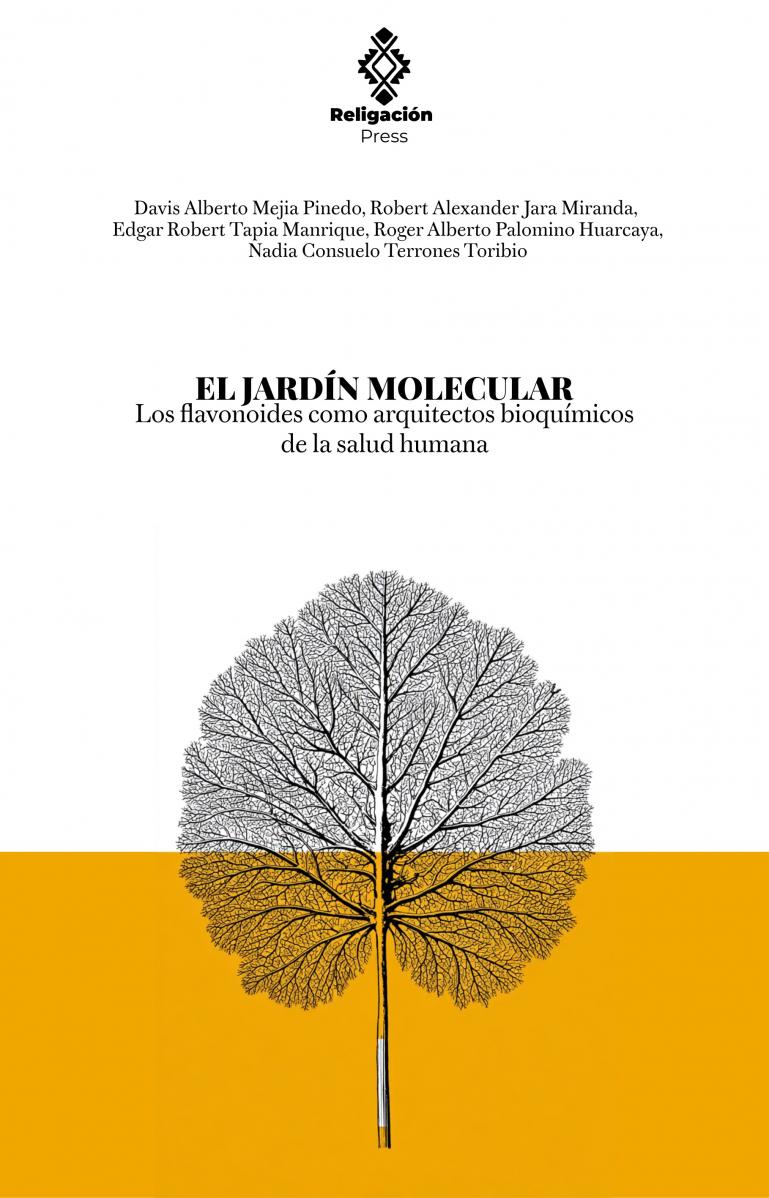
O jardim molecular. Os flavonoides como arquitetos bioquímicos da saúde humana
Palavras-chave:
Flavonoides, saúde molecular, nutrição preventiva, antioxidantes, bioquímica dos alimentos.Sinopse
Este livro narra a epopeia dos flavonoides, compostos que redefiniram nossa compreensão da dieta. Começando pela descoberta inicial de uma "complexidade bioquímica superior" além da vitamina C, a narrativa revela como essas moléculas, aperfeiçoadas pelas plantas para sua sobrevivência, encontraram um eco funcional em nossa fisiologia. Exploramos este vasto universo químico, onde milhares de estruturas atuam como uma linguagem molecular com funções biológicas essenciais. A obra tece um diálogo evolutivo milenar, demonstrando como os mecanismos que protegem um vegetal se convertem em potentes efeitos antioxidantes e moduladores da inflamação em nosso corpo. Desde seus fundamentos ecológicos até suas aplicações na medicina preventiva, esta jornada nos convida a reconsiderar cada mordida de fruta ou verdura como uma intervenção bioquímica complexa e benéfica.
Downloads
Não há dados estatísticos.
Referências
Bondonno, C. P., Croft, K. D., Ward, N., Considine, M. J., & Hodgson, J. M. (2015). Dietary flavonoids and nitrate: effects on nitric oxide and vascular function. Nutrition Reviews, 73(4), 216–235. https://doi.org/10.1093/nutrit/nuu014
Castro-Acosta, M. L., Stone, S. G., Mok, J. E., Mhajan, R. K., Fu, C. I., Lenihan-Geels, G. N., & Hall, W. L. (2017). Apple and blackcurrant polyphenol-rich drinks decrease postprandial glucose, insulin and incretin response to a high-carbohydrate meal in healthy men and women. The Journal of Nutritional Biochemistry, 49, 53–62. https://doi.org/10.1016/j.jnutbio.2017.07.013
Crozier, A., Jaganath, I. B., & Clifford, M. N. (2009). Dietary phenolics: chemistry, bioavailability and effects on health. Natural Product Reports, 26(8), 1001–1043. https://doi.org/10.1039/b802662a
Del Rio, D., Rodriguez-Mateos, A., Spencer, J. P., Tognolini, M., Borges, G., & Crozier, A. (2013). Dietary (poly)phenolics in human health: structures, bioavailability, and evidence of protective effects against chronic diseases. Antioxidants & Redox Signaling, 18(14), 1818–1892. https://doi.org/10.1089/ars.2012.4581
Grosso, G., Godos, J., Lamuela-Raventos, R., Ray, S., Micek, A., Pajak, A., ... & Galvano, F. (2017). A comprehensive meta-analysis on dietary flavonoid and lignan intake and cancer risk: Level of evidence and limitations. Molecular Nutrition & Food Research, 61(4). https://doi.org/10.1002/mnfr.201600930
Hertog, M. G., Feskens, E. J., Hollman, P. C., Katan, M. B., & Kromhout, D. (1993). Dietary antioxidant flavonoids and risk of coronary heart disease: the Zutphen Elderly Study. The Lancet, 342(8878), 1007–1011. https://doi.org/10.1016/0140-6736(93)92876-u
Hollman, P. C., de Vries, J. H., van Leeuwen, S. D., Mengelers, M. J., & Katan, M. B. (1995). Absorption of dietary quercetin glycosides and quercetin in healthy ileostomy volunteers. The American Journal of Clinical Nutrition, 62(6), 1276–1282. https://doi.org/10.1093/ajcn/62.6.1276
Hooper, L., Kay, C., Abdelhamid, A., Kroon, P. A., Cohn, J. S., Rimm, E. B., & Cassidy, A. (2012). Effects of chocolate, cocoa, and flavan-3-ols on cardiovascular health: a systematic review and meta-analysis of randomized trials. The American Journal of Clinical Nutrition, 95(3), 740–751. https://doi.org/10.3945/ajcn.111.023457
Hua, X., Yu, L., You, R., Yang, Y., Liao, J., Chen, D., & Yu, L. (2016). Association among dietary flavonoids, flavonoid subclasses and ovarian cancer risk: a meta-analysis. PLOS ONE, 11(4). https://doi.org/10.1371/journal.pone.0151134
Joseph, J. A., Shukitt-Hale, B., Denisova, N. A., Bielinski, D., Martin, A., McEwen, J. J., & Bickford, P. C. (1999). Reversals of age-related declines in neuronal signal transduction, cognitive, and motor behavioral deficits with blueberry, spinach, or strawberry dietary supplementation. The Journal of Neuroscience, 19(18), 8114–8121. https://doi.org/10.1523/JNEUROSCI.19-18-08114.1999
Knekt, P., Kumpulainen, J., Järvinen, R., Rissanen, H., Heliövaara, M., Reunanen, A., Hakulinen, T., & Aromaa, A. (2002). Flavonoid intake and risk of chronic diseases. The American Journal of Clinical Nutrition, 76(3), 560–568. https://doi.org/10.1093/ajcn/76.3.560
Krikorian, R., Shidler, M. D., Nash, T. A., Kalt, W., Vinqvist-Tymchuk, M. R., Shukitt-Hale, B., & Joseph, J. A. (2010). Blueberry supplementation improves memory in older adults. Journal of Agricultural and Food Chemistry, 58(7), 3996–4000. https://doi.org/10.1021/jf9029332
Kuriyama, S., Hozawa, A., Ohmori, K., Shimazu, T., Matsui, T., Ebihara, S., Awata, S., Nagatomi, R., Arai, H., & Tsuji, I. (2006). Green tea consumption and cognitive function: a cross-sectional study from the Tsurugaya Project 1. The American Journal of Clinical Nutrition, 83(2), 355–361. https://doi.org/10.1093/ajcn/83.2.355
Manach, C., Scalbert, A., Morand, C., Rémésy, C., & Jiménez, L. (2004). Polyphenols: food sources and bioavailability. The American Journal of Clinical Nutrition, 79(5), 727–747. https://doi.org/10.1093/ajcn/79.5.727
Middleton, E., Jr., Kandaswami, C., & Theoharides, T. C. (2000). The effects of plant flavonoids on mammalian cells: implications for inflammation, heart disease, and cancer. Pharmacological Reviews, 52(4), 673–751.
Panche, A. N., Diwan, A. D., & Chandra, S. R. (2016). Flavonoids: an overview. Journal of Nutritional Science, 5. https://doi.org/10.1017/jns.2016.41
Pietta, P. G. (2000). Flavonoids as antioxidants. Journal of Natural Products, 63(7), 1035–1042. https://doi.org/10.1021/np9904509
Rein, D., Paglieroni, T. G., Wun, T., Pearson, D. A., Schmitz, H. H., Gosselin, R., & Keen, C. L. (2000). Cocoa inhibits platelet activation and function. The American Journal of Clinical Nutrition, 72(1), 30–35. https://doi.org/10.1093/ajcn/72.1.30
Rice-Evans, C. A., Miller, N. J., & Paganga, G. (1996). Structure-antioxidant activity relationships of flavonoids and phenolic acids. Free Radical Biology and Medicine, 20(7), 933–956. https://doi.org/10.1016/0891-5849(95)02227-9
Ried, K., Sullivan, T. R., Fakler, P., Frank, O. R., & Stocks, N. P. (2017). Effect of cocoa on blood pressure. Cochrane Database of Systematic Reviews, (4). https://doi.org/10.1002/14651858.CD008893.pub3
Rimm, E. B., Katan, M. B., Ascherio, A., Stampfer, M. J., & Willett, W. C. (1996). Relation between intake of flavonoids and risk for coronary heart disease in male health professionals. Annals of Internal Medicine, 125(5), 384–389. https://doi.org/10.7326/0003-4819-125-5-199609010-00005
Scalbert, A., Johnson, I. T., & Saltmarsh, M. (2005). Polyphenols: antioxidants and beyond. The American Journal of Clinical Nutrition, 81(1), 215–217. https://doi.org/10.1093/ajcn/81.1.215S
Sesso, H. D., Gaziano, J. M., Liu, S., & Buring, J. E. (2003). Flavonoid intake and the risk of cardiovascular disease in women. The American Journal of Clinical Nutrition, 77(6), 1400–1408. https://doi.org/10.1093/ajcn/77.6.1400
Shukitt-Hale, B., Lau, F. C., & Joseph, J. A. (2008). Berry fruit supplementation and the aging brain. Journal of Agricultural and Food Chemistry, 56(3), 636–641. https://doi.org/10.1021/jf072505f
Spencer, J. P. (2008). Flavonoids: modulators of brain function? The British Journal of Nutrition, 99(1), 60–77. https://doi.org/10.1017/S0007114508965776
Szent-Györgyi, A. (1928). Observations on the function of peroxidase systems and the chemistry of the adrenal cortex: description of a new carbohydrate derivative. The Biochemical Journal, 22(6), 1387–1409. https://doi.org/10.1042/bj0221387
Tsuda, T., Horio, F., Uchida, K., Aoki, H., & Osawa, T. (2003). Dietary cyanidin 3-O-beta-D-glucoside-rich purple corn color prevents obesity and ameliorates hyperglycemia in mice. The Journal of Nutrition, 133(7), 2125–2130. https://doi.org/10.1093/jn/133.7.2125
Vita, J. A. (2005). Polyphenols and cardiovascular disease: effects on endothelial and platelet function. The American Journal of Clinical Nutrition, 81(1), 292–297. https://doi.org/10.1093/ajcn/81.1.292S
Williamson, G., & Manach, C. (2005). Bioavailability and bioefficacy of polyphenols in humans. II. Review of 93 intervention studies. The American Journal of Clinical Nutrition, 81(1), 243–255. https://doi.org/10.1093/ajcn/81.1.243S
Williams, R. J., Spencer, J. P., & Rice-Evans, C. (2004). Flavonoids: antioxidants or signalling molecules? Free Radical Biology and Medicine, 36(7), 838–849. https://doi.org/10.1016/j.freeradbiomed.2004.01.001
Publicado
November 5, 2025
Séries
Copyright (c) 2025 Davis Alberto Mejia Pinedo, Robert Alexander Jara Miranda, Edgar Robert Tapia Manrique, Roger Alberto Palomino Huarcaya, Nadia Consuelo Terrones Toribio
Licença

Este trabalho está licenciado sob uma licença Creative Commons Attribution 4.0 International License.
Detalhes sobre o formato disponível para publicação: PDF
PDF
ISBN-13 (15)
978-9942-561-88-6
Publication date (01)
2025-11-05