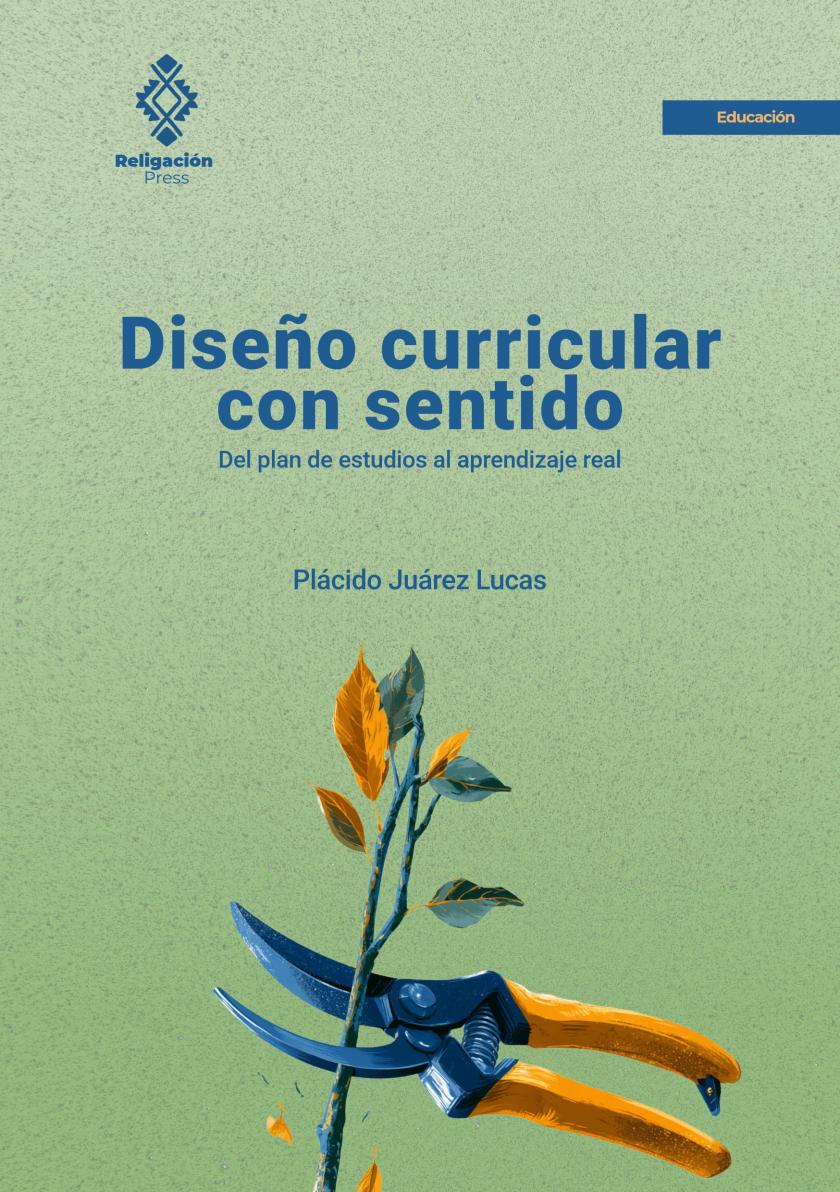
Design Curricular com Sentido. Do Plano de Estudos à Aprendizagem Real
Palavras-chave:
Desenho curricular, Autonomia docente, Desenvolvimento curricular, Planejamento educacional, Educação baseada em competências.Sinopse
Este livro nasce de uma pergunta incômoda: por que tantos professores bem-intencionados acabam ensinando sempre a mesma coisa, da mesma maneira, mesmo quando o programa oficial diz o contrário? A resposta não é falta de vontade, mas a ausência de ferramentas para tomar decisões curriculares com critério próprio. Diante da sobrecarga de conteúdos, da pressão para "cobrir" o programa e da confusão em torno da Nova Escola Mexicana, esta obra oferece fundamentos teóricos e ferramentas práticas para que o docente recupere sua autonomia profissional: distinguir o essencial do acessório, projetar com coluna vertebral disciplinar, podar sem culpa e avaliar seu próprio currículo. Um livro para professores que querem que seus alunos aprendam com profundidade e sentido.
Downloads
Não há dados estatísticos.
Referências
Anyon, J. (1980). Social class and the hidden curriculum of work. Journal of Education, 162(1), 67–92.
Apple, M. W. (1990). Ideología y currículo. Akal.
Ausubel, D. P. (1968). Educational psychology: A cognitive view. Holt, Rinehart & Winston.
Barrows, H. S., & Tamblyn, R. M. (1980). Problem-based learning: An approach to medical education. Springer.
Bereiter, C. (2002). Education and mind in the knowledge age. Lawrence Erlbaum.
Bernstein, B. (1996). La estructura del discurso pedagógico. Morata.
Bertely, M. (2006). Educación indígena en México: Políticas y prácticas. CIESAS.
Black, P., & Wiliam, D. (1998). Assessment and classroom learning. Assessment in Education: Principles, Policy & Practice, 5(1), 7–74.
Bloom, H. (1994). The Western canon: The books and school of the ages. Harcourt Brace.
Bobbit, J. F. (1918). The curriculum. Houghton Mifflin.
Bonfil Batalla, G. (1987). México profundo: Una civilización negada. CIESAS.
Bourdieu, P. (1979). La distinción: Criterio y bases sociales del gusto. Minuit.
Bourdieu, P., & Passeron, J. C. (1970). La reproducción: Elementos para una teoría del sistema de enseñanza. Siglo XXI.
Bransford, J. D., Brown, A. L., & Cocking, R. R. (2000). How people learn: Brain, mind, experience, and school. National Academy Press.
Brown, P. C., Roediger, H. L., & McDaniel, M. A. (2014). Make it stick: The science of successful learning. Harvard University Press.
Bruner, J. S. (1960). The process of education. Harvard University Press.
Bruner, J. S. (1966). Toward a theory of instruction. Harvard University Press.
Calvo, G., & Lomas, C. (2016). Género y educación: La escuela como espacio de reproducción y transformación. Octaedro.
Coll, C. (1987). Psicología y currículum. Paidós.
Connell, R. W. (1993). Schools and social justice. Temple University Press.
Connell, R. W. (1995). Poverty and education. Harvard Educational Review, 64(2), 125–149.
Dewey, J. (1916). Democracy and education. Macmillan.
Dewey, J. (1933). How we think: A restatement of the relation of reflective thinking to the educative process. D. C. Heath.
Díaz-Barriga, Á. (2015). Currículo: Debates y perspectivas. Universidad Nacional Autónoma de México.
Díaz-Barriga, Á. (2020). La investigación curricular en México: Una década de producción (2010-2020). En COMIE, (ed.). La investigación educativa en México 2010-2020 (pp. 45–78). COMIE.
Díaz-Polanco, H. (2006). Elogio de la diversidad: Globalización, multiculturalismo y etnofagia. Siglo XXI.
Doyle, W. (1992). Curriculum and pedagogy. En P. W. Jackson, (ed.), Handbook of research on curriculum (pp. 486–516). Macmillan.
Dubet, F. (2006). La escuela de las oportunidades: ¿Qué es una escuela justa? Gedisa.
Eisner, E. W. (1979). The educational imagination: On the design and evaluation of school programs. Macmillan.
Fraser, N. (2008). Escalas de justicia. Herder.
Freire, P. (1970). Pedagogía del oprimido. Siglo XXI.
Fullan, M. (2007). The new meaning of educational change. Teachers College Press.
Furlán, A. (2021). La reforma curricular en México: Tensiones entre norma y práctica docente. Universidad Nacional Autónoma de México.
Gaddis, J. L. (2002). The landscape of history: How historians map the past. Oxford University Press.
Gardner, H. (1999). The disciplined mind: What all students should understand. Simon & Schuster.
Gardner, H., & Boix-Mansilla, V. (1994). Teaching for understanding in the disciplines and beyond. Teachers College Record, 96(2), 198–218.
Gay, G. (2010). Culturally responsive teaching: Theory, research, and practice (2nd ed.). Teachers College Press.
Gimeno Sacristán, J. (2010). Saberes e incertidumbres sobre el currículo. Morata.
Giroux, H. A. (1997). Los profesores como intelectuales transformativos. Paidós.
Good, T. L., & Brophy, J. E. (2000). Looking in classrooms. Longman.
Goodlad, J. I., & Su, Z. (1992). Organization of the curriculum. En P. W. Jackson, (ed.). Handbook of research on curriculum (pp. 327–344). Macmillan.
Grossman, P. L. (1990). The making of a teacher: Teacher knowledge and teacher education. Teachers College Press.
Hargreaves, A. (2003). Enseñar en la sociedad del conocimiento. Octaedro.
Hirsch, E. D. (1987). Cultural literacy: What every American needs to know. Houghton Mifflin.
hooks, b. (1994). Teaching to transgress: Education as the practice of freedom. Routledge.
INALI. (2008). Catálogo de las lenguas indígenas nacionales. Instituto Nacional de Lenguas Indígenas.
INEE. (2019). La educación obligatoria en México: Informe 2019. Instituto Nacional para la Evaluación de la Educación.
Jackson, P. W. (1968). La vida en las aulas. Morata.
Jacobs, H. H. (Ed.). (1989). Interdisciplinary curriculum: Design and implementation. Association for Supervision and Curriculum Development.
Jussim, L., & Harber, K. D. (2005). Teacher expectations and self-fulfilling prophecies: Knowns and unknowns, resolved and unresolved controversies. Personality and Social Psychology Review, 9(2), 131–155.
Kilpatrick, W. H. (1918). The project method. Teachers College Record, 19(4), 319–335.
Klein, J. T. (1990). Interdisciplinarity: History, theory, and practice. Wayne State University Press.
Krajcik, J. S., & Blumenfeld, P. C. (2006). Project-based learning. En R. K. Sawyer, (ed.). The Cambridge handbook of the learning sciences (pp. 317–334). Cambridge University Press.
Ladson-Billings, G. (1995). Toward a theory of culturally relevant pedagogy. American Educational Research Journal, 32(3), 465–491.
Lerner, G. (2012). La creación de la conciencia feminista. Universidad Nacional Autónoma de México.
Menéndez, E. L. (2005). La parte negada de la cultura: Relativismo, diferencias y racismo. Bellaterra.
Moll, L. C., Amanti, C., Neff, D., & González, N. (1992). Funds of knowledge for teaching: Using a qualitative approach to connect homes and classrooms. Theory Into Practice, 31(2), 132–141.
Morin, E. (1999). Los siete saberes necesarios para la educación del futuro. UNESCO.
National Research Council. (2001). Adding it up: Helping children learn mathematics. National Academy Press.
Nicolescu, B. (2002). Manifesto of transdisciplinarity. State University of New York Press.
Nussbaum, M. C. (2010). Sin fines de lucro: Por qué la democracia necesita de las humanidades. Katz.
Oakes, J. (1985). Keeping track: How schools structure inequality. Yale University Press.
OECD. (2019). PISA 2018 results (Volume I): What students know and can do. OECD Publishing.
Perkins, D. N., & Salomon, G. (2012). Knowledge to go: A motivational and dispositional view of transfer. Educational Psychologist, 47(3), 248–258.
Pinar, W. F. (2012). What is curriculum theory? Routledge.
Posner, G. J., & Strike, K. A. (1976). A categorization scheme for principles of sequencing content. Review of Educational Research, 46(4), 665–690.
Rist, R. C. (1970). Student social class and teacher expectations: The self-fulfilling prophecy in ghetto education. Harvard Educational Review, 40(3), 411–451.
Rockwell, E. (2018). La experiencia docente en contextos rurales e indígenas. DIE-CINVESTAV.
Rosenblatt, L. M. (1978). The reader, the text, the poem: The transactional theory of the literary work. Southern Illinois University Press.
Rosenthal, R., & Jacobson, L. (1968). Pygmalion in the classroom: Teacher expectation and pupils’ intellectual development. Holt, Rinehart & Winston.
Sánchez-Olavarría, C. (2025). Autonomía curricular y práctica docente en la Nueva Escuela Mexicana: Un estudio etnográfico en Tlaxcala. Revista Mexicana de Investigación Educativa, 30(1), 65–92.
Schön, D. A. (1983). The reflective practitioner: How professionals think in action. Basic Books.
Schwab, J. J. (1973). The practical 3: Translation into curriculum. The School Review, 81(4), 501–522.
SEP. (2017). Programa de estudios de Educación Media Superior: Comunicación y Lenguaje. Secretaría de Educación Pública.
SEP. (2022). Marco curricular y Plan de estudios 2022 de la Educación Básica Mexicana. Secretaría de Educación Pública.
Shulman, L. S. (1986). Those who understand: Knowledge growth in teaching. Educational Researcher, 15(2), 4–14.
Stenhouse, L. (1985). La investigación como base de la enseñanza. Morata.
Stenhouse, L. (1991). Investigación y desarrollo del currículo. Morata.
Sweller, J. (1988). Cognitive load during problem solving: Effects on learning. Cognitive Science, 12(2), 257–285.
Taba, H. (1962). Curriculum development: Theory and practice. Harcourt, Brace & World.
Tardif, M. (2014). Los saberes del docente y su desarrollo profesional. Narcea.
Thomas, J. W. (2000). A review of research on project-based learning. Autodesk Foundation.
Toledo, V. M., & Barrera-Bassols, N. (2008). La memoria biocultural: La importancia ecológica de las sabidurías tradicionales. Icaria.
Torres Santomé, J. (1994). El currículum oculto. Morata.
Torres Santomé, J. (2011). La justicia curricular: El caballo de Troya de la cultura escolar. Morata.
Tyler, R. W. (1949). Basic principles of curriculum and instruction. University of Chicago Press.
Vygotsky, L. S. (1978). Mind in society: The development of higher psychological processes. Harvard University Press.
Westbury, I. (2008). Making curricula: Why do states make curricula, and how? En F. M. Connelly, M. F. He, & J. Phillion, (eds.). The SAGE handbook of curriculum and instruction (pp. 45–65). SAGE Publications.
Wiggins, G., & McTighe, J. (2005). Understanding by design. Association for Supervision and Curriculum Development.
Wineburg, S. (2001). Historical thinking and other unnatural acts: Charting the future of teaching the past. Temple University Press.
Young, M. F. D. (2008). Bringing knowledge back in: From social constructivism to social realism in the sociology of education. Routledge.
Publicado
September 22, 2026
Séries
Copyright (c) 2026 Plácido Juárez Lucas
Licença

Este trabalho está licenciado sob uma licença Creative Commons Attribution 4.0 International License.
Detalhes sobre o formato disponível para publicação: PDF
PDF
ISBN-13 (15)
978-9907-845-13-6
Publication date (01)
2026-09-22